
 Nana Banana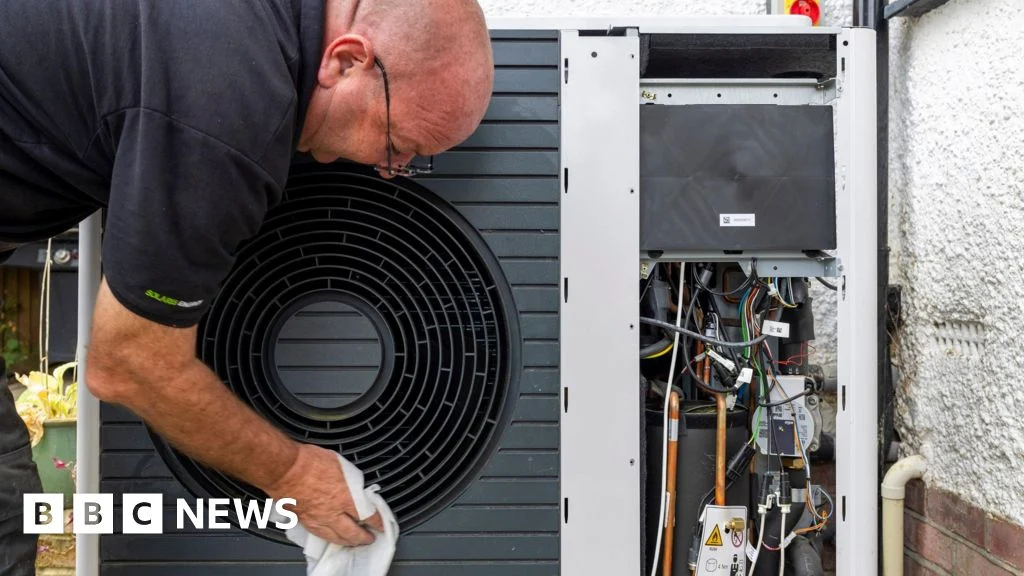
How do heat pumps work? The Science of Efficient Heating and Cooling
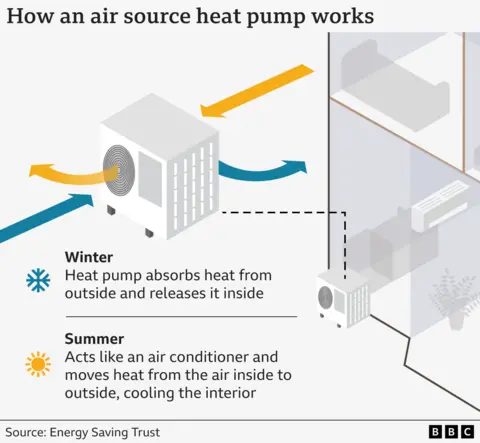
At their core, heat pumps operate on a principle similar to a refrigerator, but in reverse. Instead of expelling heat from an enclosed space, they absorb and amplify existing ambient heat from the air, ground, or even water, and transfer it into a building. They run on electricity, making them significantly more efficient than traditional fossil fuel boilers, which generate heat by burning fuel.
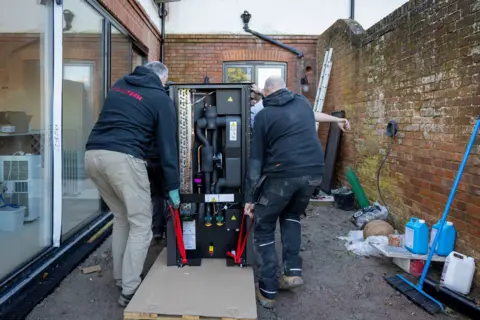
The most prevalent type, air source heat pumps (ASHPs), consist of an outdoor unit, typically measuring around 1m x 1m x 0.4m, which resembles an air conditioning unit. This unit draws in outdoor air and passes it over coils containing a refrigerant fluid. Even in cold temperatures, there’s enough latent heat in the air to cause the refrigerant to evaporate into a gas. This low-temperature, low-pressure gas then enters a compressor, where its pressure is dramatically increased. As the gas is compressed, its temperature rises significantly. This high-temperature, high-pressure gas then flows through a condenser coil inside the property, transferring its heat to the home’s heating system (radiators or underfloor heating) and hot water cylinder. As the heat is released, the refrigerant cools and condenses back into a liquid. Finally, an expansion valve reduces the pressure of the liquid refrigerant, cooling it further, and the cycle repeats.
Beyond just heating, many modern heat pumps are reversible, meaning they can also provide cooling during warmer months by reversing the refrigeration cycle, effectively acting as an air conditioner. The indoor components typically include a heat pump unit, roughly the size of a standard gas boiler, and a hot water cylinder, the size of which varies depending on the property’s hot water demands.
While air source heat pumps are more common due to their easier installation, ground source heat pumps (GSHPs) offer even greater efficiency and consistency. They harness the stable temperature of the earth a few metres below the surface. However, their installation is more complex and expensive, requiring either extensive horizontal trenches or deep boreholes to bury the ground loops that absorb heat. Water source heat pumps, a less common variant, draw heat from nearby bodies of water like rivers or lakes. The choice between these systems depends on property type, available land, and budget, with air source models being the most adaptable for existing homes.
How much do heat pumps cost and what funding is available? Navigating the Investment
The upfront cost of installing a heat pump can be a significant barrier for many homeowners, though government support is designed to mitigate this. Before grants, the typical cost for an air source heat pump installation in the UK ranges from £8,000 to £18,000, while ground source heat pumps, due to the excavation work, can cost anywhere from £15,000 to £35,000. These figures include the unit, installation, and any necessary upgrades to the existing heating system, such as larger radiators or underfloor heating to maximise efficiency.
To encourage wider adoption, the UK government offers substantial financial incentives. The flagship initiative is the Boiler Upgrade Scheme (BUS), which provides a grant of £7,500 towards the cost of installing an air source or ground source heat pump for eligible homeowners in England and Wales. This scheme has been extended to 2029/30, offering long-term certainty. To qualify, properties must have an eligible Energy Performance Certificate (EPC) issued within the last 10 years. Crucially, a recent change has removed the previous requirement for properties to have existing loft or cavity wall insulation to be eligible for the grant, potentially saving homeowners an additional £2,500 in upfront insulation costs. This aims to simplify the application process and broaden eligibility.
For low-income households and those residing in social housing, additional support is available through the government’s £5 billion Social Housing Decarbonisation Fund and the Warm Homes Local Grant. The Warm Homes Local Grant, administered by local authorities in England, provides funding for a range of energy efficiency improvements, including insulation, solar panels, and air source heat pumps, for some private owners or renters. Properties must have an EPC rating of between D and G to qualify, targeting those most in need of energy upgrades. These schemes aim to ensure that the transition to greener heating is equitable and accessible, preventing a two-tier system where only affluent homeowners can afford the switch.
Can heat pumps cut bills? Efficiency, Energy Prices, and Long-Term Savings
While the initial investment in a heat pump is substantial, the long-term running costs can be significantly lower than traditional gas boilers, particularly as the UK energy landscape evolves. The Climate Change Committee (CCC), which advises the UK government on emissions reduction, projects that heat pumps will become cheaper to run than gas boilers.
The key to a heat pump’s efficiency lies in its Coefficient of Performance (COP), which measures the ratio of heat output to electricity input. A typical modern heat pump has a COP of 3 to 4, meaning for every 1 unit of electricity consumed, it generates 3 to 4 units of heat. This contrasts sharply with even the most efficient gas boilers, which have an efficiency rating of around 90-95%, meaning for every unit of gas burned, they produce slightly less than one unit of heat.
However, current running cost savings depend heavily on the fluctuating prices of electricity versus gas. Historically, electricity has been more expensive per unit than gas. This is partly because the cost of electricity in the UK and globally is still heavily influenced by gas prices, as gas-fired power stations often set the marginal price of electricity. Nevertheless, the government anticipates this dynamic will shift as the proportion of renewable energy in the grid continues to expand, leading to a decoupling of electricity and gas prices and potentially cheaper electricity.
Maximising savings also requires an adequately insulated home. Heat pumps operate most efficiently when providing a consistent, lower temperature heat over longer periods, making good insulation essential to retain that warmth. Property suitability, including the potential need for larger radiators or underfloor heating systems that work better with lower flow temperatures, is also a factor.
Households that combine heat pump installation with solar panels can unlock even greater savings. By generating their own electricity, they reduce their reliance on grid electricity, directly offsetting the heat pump’s power consumption. The innovation charity Nesta estimates that an average home equipped with both a heat pump and solar panels could reduce its annual energy bill by nearly £1,000, illustrating the powerful synergy between these two green technologies. Furthermore, smart controls and zoning capabilities can optimise heat pump performance, allowing homeowners to heat only the areas they need, when they need them, further enhancing efficiency and reducing costs.
Are heat pumps noisy? Addressing a Common Misconception
One of the historical concerns surrounding air source heat pumps was the potential for noise disturbance, particularly in densely populated areas. Previously, planning permission was often required to install a heat pump within 1 metre (3 feet) of a neighbour’s property, a rule that acted as a significant deterrent to uptake.
However, this regulation has been relaxed, primarily due to advancements in technology and a broader understanding of heat pump acoustics. Modern heat pump units are significantly quieter than their predecessors. New devices are now required to operate below 42 decibels (dB), a noise level comparable to that of a household refrigerator, a quiet office, or the hum of a library. For context, a normal conversation typically registers around 60 dB. This substantial reduction in operational noise has largely alleviated concerns about neighbourly disputes and comfort.
The relaxation of rules also extends to the size and number of heat pumps households can install. This increased flexibility makes it easier for larger properties or those with specific heating demands to implement multiple units without undue bureaucratic hurdles. While placement still plays a role in minimising any perceived noise, the improvements in design mean that most homeowners will find the sound of a modern heat pump barely noticeable, ensuring a peaceful living environment.
How many heat pumps have been installed in the UK? Progress and Future Targets
Despite their clear benefits and increasing government support, the UK lags behind many other major European countries in heat pump adoption. Nations like France, Germany, and Italy have significantly higher installation rates, often due to longer-standing policy support, a different heating infrastructure, and greater public awareness.
Historically, the UK’s reliance on a well-developed gas grid has meant that gas boilers have been the default heating solution for decades, leading to lower public familiarity with alternative systems. In 2023, while over 1.7 million new gas boilers were installed, the number of heat pump installations, though growing, remained considerably lower.
However, the trajectory is set for rapid acceleration. The Climate Change Committee (CCC) highlights the urgency of scaling up heat pump deployment to meet the UK’s ambitious climate targets. Their projections indicate a need for nearly 450,000 heat pump installations annually by 2030, surging to 1.5 million per year by 2035. This monumental shift will require not only continued financial incentives and public education but also a significant expansion of the installer workforce and robust supply chains.
The new building regulations in England, mandating heat pumps and solar panels in all new homes, represent a crucial step towards normalising these technologies. This will drive market growth, foster innovation, and increase the number of trained installers, creating a positive feedback loop that will accelerate the transition away from fossil fuel heating. The government is also actively exploring strategies to further reduce the price of electricity relative to gas, making the running costs of heat pumps even more attractive. As the UK moves towards a greener energy future, heat pumps are set to become a ubiquitous and essential component of sustainable living.




 George Anjay
 Nakalama John
 atisusanti
 Ramos Leo
 Roy Suryo