George Anjay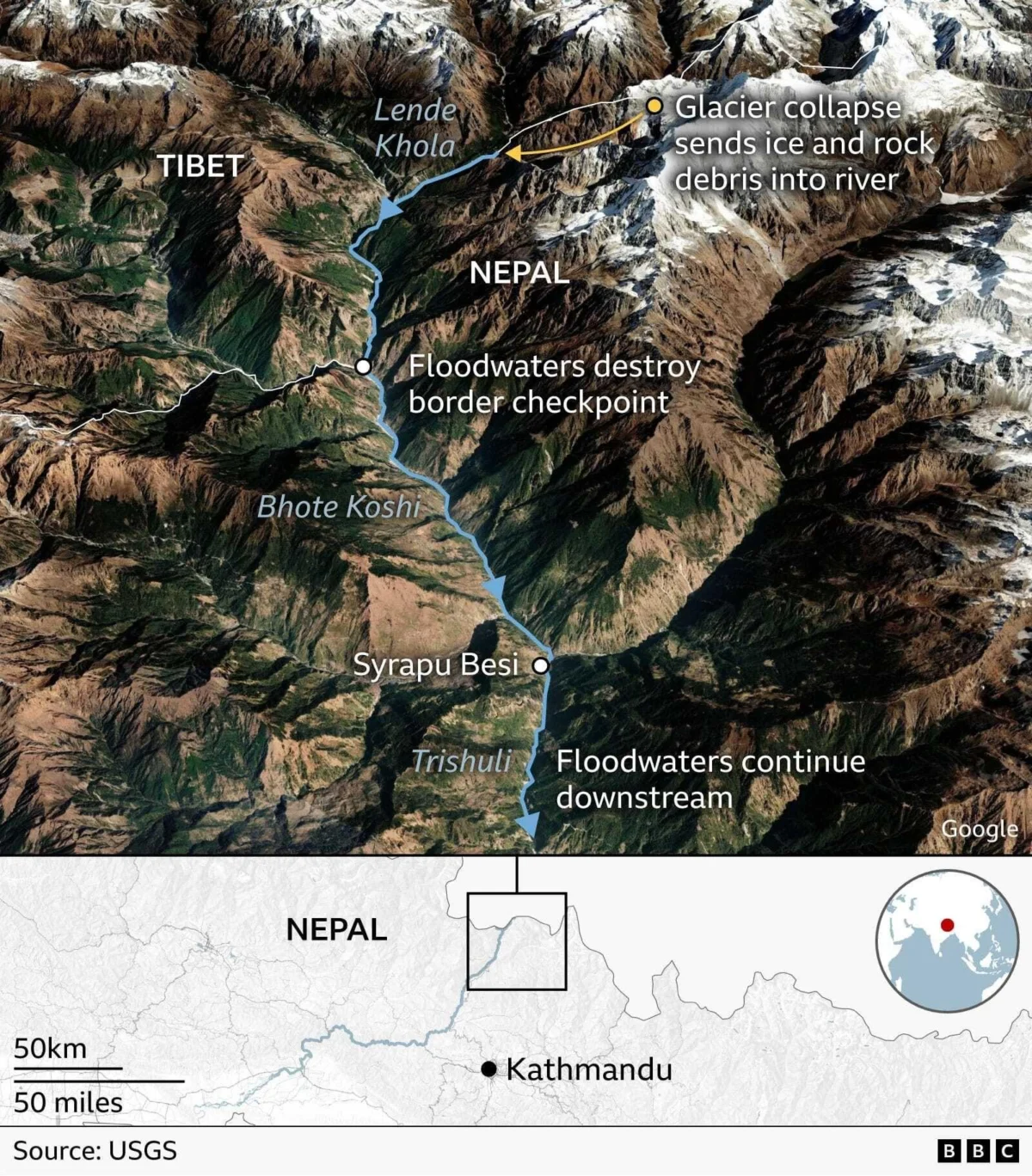
Devastating landslides and flash floods on the Nepal-Tibet border have caused widespread damage and left hundreds dead or missing, with the disaster originating from a glacial collapse that triggered a powerful deluge. At least 489 people have been confirmed dead, and a staggering 977 individuals remain unaccounted for, two days after the catastrophic event tore through the border region, obliterating homes and critical infrastructure. Rescue workers are now engaged in a desperate race against time to reach any remaining survivors, as fears escalate of further flooding in the disaster’s wake.
The catastrophic event initially led to widespread belief that an earthquake had triggered a landslide, which subsequently caused the devastating floods early on Wednesday. However, the US Geological Survey (USGS) later clarified that the disaster was caused by a "glacial collapse," a phenomenon where a glacier or a significant portion of it disintegrates. The immense impact of the collapsed glacier striking the valley floor was so powerful that it registered a magnitude of 5.2 on the Richter scale, according to the agency, leading to "subsequent catastrophic impacts downstream." This glacial collapse sent a colossal wave of ice and rock debris cascading into the river systems, initiating the destructive downstream flow.
The powerful floodwaters and debris travelled approximately 62 miles (100km) downstream from the Trishuli and Bhote Koshi Rivers, the USGS reported, inundating towns that are popular destinations for mountaineering tourists and religious pilgrims in northern Nepal. Harrowing video footage captured the terrifying spectacle of a wall of mud and rock sweeping away buildings, roads, and vehicles, as residents desperately fled the fast-moving torrent. In one particularly chilling video, a towering wall of water and mud was seen rushing down a gorge along the Trishuli River, engulfing the Rasuwagadhi Border checkpoint, a multi-storey building situated on the Nepalese side of the border. Gyirong Port, located across the border in Tibet, was also severely impacted, with numerous deaths reported in Tibetan villages.

Scientists are diligently working to reconstruct the precise sequence of events as rescue efforts continue. Professor Mike Searle, a leading Earth scientist at Oxford University, suggested that the glacier could have collapsed "hours or days" before the flooding reached Nepal and Tibet. He explained to the BBC that "the sheer wave of debris suggests there was a landslide first, the water built up, (which) dammed the river, and then it burst in one huge great flood." This sequence implies a complex interaction between glacial instability, landslide dynamics, and river hydrology.
The International Centre for Integrated Mountain Development (ICIMOD) has issued a grave warning of potential secondary flooding in the coming days due to the substantial volume of debris that has washed into the river systems. The ICIMOD is actively assessing whether the Trishuli River has been temporarily dammed in narrower sections. If a blockage has occurred, there is a significant risk of a landslide dam forming, which could subsequently lead to a catastrophic second flood. In a separate but related concern, China has alerted to a "high risk" that a lake formed by the landslide may breach its banks, potentially causing a new flood downstream. State media reported that rescue operations were briefly halted on Friday when the lake, situated at the confluence of the Chhochen Khola and Purepu Tsangpo rivers, overflowed, although water levels subsequently dropped slightly. Forecasters predict heavy rainfall over the next few days, exacerbating the risk of further instability.
The human toll of this disaster is still being fully assessed, with the number of people killed or missing fluctuating as information emerges. As of Friday, Nepali police reported at least 489 fatalities, while the country’s disaster agency stated that 977 people remained missing as of Friday afternoon. The Nepali government has released a list of over 500 foreign nationals who have been out of contact since the floods, including 33 British nationals. Among the missing are also 44 members of the Nepali army and 28 police officers, according to disaster officials. In Tibet, China’s state broadcaster CCTV reported five deaths and 558 missing persons on Friday. It remains unclear whether there is any overlap between the missing persons counted in the Nepali and Chinese figures. China’s Premier Li Qiang arrived in Gyirong on Thursday to personally oversee rescue and relief operations in this critical border crossing point for tourists and commercial traffic between China and Nepal. Brigadier General Rajaram Basnet, a spokesperson for the Nepali army, highlighted the significant challenges faced by rescue operations due to persistent rain and unpredictable weather conditions in the affected region.

Tourists from around the globe are drawn to Nepal for its majestic mountains and profound spiritual sites, and reports of missing individuals include travelers from a wide range of nationalities. Among those unaccounted for are significant numbers of tourists from the United States, the United Kingdom, Germany, and Canada. Smaller groups of travelers from South Korea, South Africa, Portugal, the Netherlands, and New Zealand are also among the missing.
Governments worldwide have mobilized to respond to the crisis. Nepal’s Prime Minister Balendra Shah expressed that "the entire nation has been left shocked and deeply distressed" and assured that officials would coordinate closely with China on the relief efforts. China’s President Xi Jinping urged an "all-out" search and rescue operation and pledged to enhance monitoring and early warning systems to prevent future calamities. In neighboring India, Prime Minister Narendra Modi stated that his government was "prepared to provide Nepal with all possible types of humanitarian assistance." UN Secretary General António Guterres conveyed his sorrow over the severe flooding, noting that UN teams and partners are actively deploying supplies and personnel to support Nepal’s government-led response. The United States has pledged $500,000 in aid to address emergency shelter, water, sanitation, and other critical relief needs for the affected communities. The United Kingdom has offered £5 million to assist the Nepalese government and committed to providing "everything we can" to support British nationals in Nepal.
The potential role of climate change in this catastrophic event is a significant point of concern. Climate change is a well-documented driver of accelerated glacier melt in the Hindu Kush Himalaya region, a fact that geologist Daniel Shugar, among the first experts to hypothesize a glacial cause for the flooding, emphasized. Shugar, based at the University of Calgary in Canada, explained that glacial thinning, exacerbated by global warming, could indeed increase the susceptibility of mountainsides to landslides. However, he cautioned that it is still premature to definitively link this specific event to climate change. Simon Cook, a geoscientist at the University of Dundee, corroborated the potential impact of climate change, stating that his team believes they have identified the location of the collapse. Cook estimated that the lower part of a glacier near Nepal’s Langtang Lirung peak, approximately 15km (9 miles) west of the flood site, had collapsed. He further posited that the glacier collapse likely occurred in a north-westerly direction before travelling westward downstream. Cook elaborated, "permafrost is partially holding some mountainsides together, this permafrost is warming and thawing and degrading so you are going to get more landslides." This highlights a broader trend of increasing geological instability in high-mountain environments due to warming temperatures.




 Roy Suryo

 Nakalama John
 atisusanti
 Ramos Leo