Nana Banana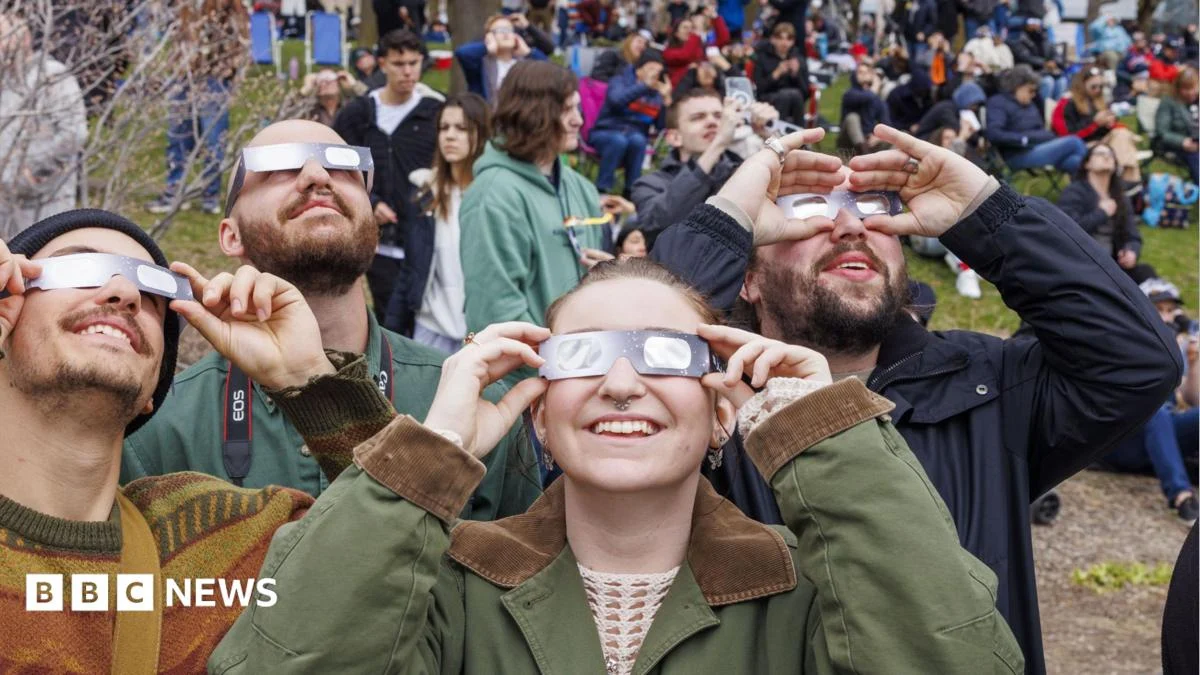
People across England have a rare and spectacular chance to experience a dramatic partial solar eclipse today, an astronomical event where the Sun will be almost entirely blocked by the Moon. This highly anticipated celestial spectacle is a truly significant occurrence, offering a breathtaking display of the cosmos from our own skies. Such a high degree of solar obscuration has not been widely visible across the United Kingdom since the total solar eclipse of August 11, 1999, making today’s event a generational viewing opportunity for many.
The Moon is projected to cover an impressive 90 to 96 per cent of the Sun in the early evening hours, depending on the observer’s location within England. This extensive coverage means that instead of a faint sliver, the Sun will appear as a dramatic, slender crescent, with the sky potentially dimming noticeably, akin to deep twilight, even though it occurs during daylight hours. The difference between 90% and 96% coverage might seem small, but visually, the greater the obscuration, the more profound the effect on ambient light and the more striking the crescent Sun will appear. This level of partial eclipse offers a unique insight into the intricate dance of celestial bodies, reminding us of the vast cosmic mechanisms at play above us.
The celestial event will unfold over approximately one hour and 50 minutes, commencing around 18:20 BST and concluding by 20:10 BST. However, these timings are approximate, and the precise start, peak, and end times will exhibit slight variations depending on one’s geographical position across England. For instance, observers in the far South West, such as Cornwall, might experience the eclipse beginning a few minutes earlier, reaching its peak around 19:15 BST, and ending closer to 20:05 BST, with the maximum obscuration. Further north and east, in regions like London, the eclipse might begin closer to 18:25 BST, peak around 19:18 BST, and finish nearer to 20:10 BST, potentially with a slightly lower percentage of coverage. In the North East, for example around Newcastle, the event could start around 18:30 BST, peak around 19:22 BST, and conclude closer to 20:15 BST. These subtle differences underscore the dynamic nature of the Moon’s shadow traversing the Earth’s surface.
Geographical location plays a crucial role in determining the extent of the spectacle. People residing in the South West of England are expected to witness the most significant coverage within the country, benefiting from their proximity to the path of totality. Areas like Cornwall, Devon, and Somerset will be prime locations for experiencing the deepest partial eclipse, with the Sun potentially being 95-96% obscured. While England will experience a profound partial eclipse, the rare phenomenon of a total solar eclipse, where the Sun is completely hidden, will be visible further afield. Parts of Greenland, Iceland, and northern Spain are positioned directly in the path of totality, where observers will witness the awe-inspiring sight of the Sun’s corona becoming visible. This distinction highlights the delicate geometry required for a total eclipse, which demands perfect alignment between the Sun, Moon, and Earth.
Given the inherent dangers of looking directly at the Sun, safety during eclipse viewing is paramount. Staring at the Sun, even for a brief moment during a partial eclipse, can cause permanent eye damage, including blindness. The human eye does not have pain receptors in the retina, meaning damage can occur without any immediate discomfort. Therefore, under no circumstances should anyone attempt to view the eclipse with the naked eye or through standard sunglasses, smoked glass, exposed photographic film, or any other uncertified filters. These methods offer insufficient protection and can be extremely hazardous.
The only safe ways to observe the partial solar eclipse are through certified eclipse glasses or viewers that meet the ISO 12312-2 international safety standard. These specialized filters are designed to block harmful ultraviolet, infrared, and intense visible light. Alternatively, indirect viewing methods, such as a pinhole projector, offer a perfectly safe and engaging way to watch the eclipse. A simple pinhole projector can be fashioned from two pieces of card, allowing the Sun’s image to be safely projected onto a surface. Telescopes and binoculars can also be used, but only if they are fitted with approved solar filters specifically designed for astronomical instruments, placed over the objective lens, not at the eyepiece. Public viewing events often provide access to these specialized instruments under expert supervision.
To mark this extraordinary occasion, dozens of celestial events are being organised across the country. Local astronomical societies, science museums, universities, and observatories are hosting public viewing sessions, providing safe and informative environments for people to experience the eclipse. Institutions such as the Royal Observatory Greenwich, Jodrell Bank Centre for Astrophysics, and various regional astronomy clubs will likely be opening their doors, offering expert guidance and specialized equipment. These events are not only opportunities for safe viewing but also for learning about the science behind eclipses, engaging with astronomers, and sharing the wonder of the cosmos with fellow enthusiasts. Checking the websites of local science centres or university physics departments is highly recommended for those seeking organised viewing opportunities.
The occurrence of a solar eclipse is a powerful demonstration of orbital mechanics. It happens when the Moon passes directly between the Sun and Earth, casting a shadow on our planet. A partial eclipse occurs when the alignment is not perfect, and only part of the Sun is obscured by the Moon. The specific geometry and timing of today’s event are a result of the Moon’s elliptical orbit around the Earth and the Earth’s elliptical orbit around the Sun. While solar eclipses happen periodically, the visibility of a significant partial eclipse from a specific location like England is much rarer, owing to the narrow path of the Moon’s shadow. For scientists, eclipses offer invaluable opportunities to study the Sun’s outer atmosphere, the corona, which is usually hidden by the Sun’s bright face. Though less prominent during a partial eclipse, the dimming of the sky and the sharp crescent shape provide data for atmospheric studies and public engagement.
Historically, solar eclipses have captivated humanity, inspiring both awe and apprehension. Ancient civilizations often interpreted these events as omens, divine interventions, or the devouring of the Sun by mythical beasts. Today, with a scientific understanding of their cause, eclipses continue to evoke a sense of wonder and connection to the vastness of the universe, albeit through a lens of knowledge rather than superstition. This blend of ancient mystique and modern scientific understanding makes eclipse viewing a uniquely profound experience.
While the anticipation for clear skies is high, British weather can be notoriously unpredictable. Should clouds obscure the view in some areas, many observatories and scientific institutions worldwide will be providing live streams of the eclipse, offering an alternative way to witness the event from locations with clearer visibility, including the path of totality. These online resources ensure that everyone can partake in the spectacle, regardless of local weather conditions. Looking ahead, the next significant partial solar eclipse visible from the UK will occur in August 2026, with totality in Spain, while a total solar eclipse over parts of the UK is not expected until 2090, underscoring the exceptional nature of today’s event.
For more detailed information on local viewing events, precise timings specific to your postcode, and the most up-to-date safety guidelines, residents are strongly encouraged to consult local astronomical societies, science museums, reputable meteorological websites, and trusted national news outlets. Preparation and adherence to safety protocols will ensure that this rare partial solar eclipse can be enjoyed safely and memorably by all across England.



 George Anjay
 Nakalama John
 Ramos Leo