
 Nana Banana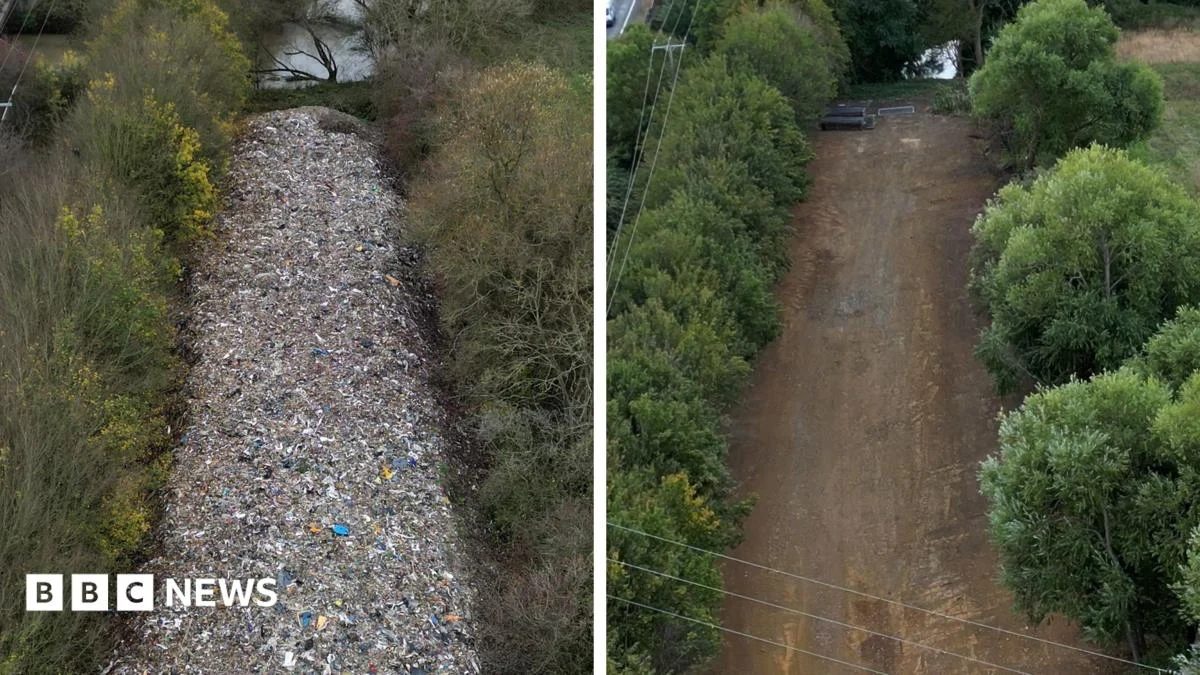
The government has expressed its firm resolve to claw back these clearance costs, not just for the Kidlington site but also for seven other major illegal dumps, from the criminal masterminds responsible. However, figures obtained by the BBC reveal a concerning disparity between the cost of remediation and the funds successfully recovered from offenders, raising serious questions about the effectiveness of current deterrents.
For years, the site in Kidlington became a festering wound on the Oxfordshire landscape, a vast and unsanctioned landfill situated precariously between the tranquil River Cherwell and the bustling A34 road. Leading up to and around 2025, an estimated 22,000 tonnes of diverse waste – encompassing everything from domestic refuse and commercial discards to construction rubble and potentially hazardous materials – was illicitly deposited there. The sheer volume of waste, equivalent to over a thousand fully laden lorries, transformed a once-green area into an environmental hazard, threatening the delicate ecosystem of the Cherwell, polluting local groundwater, and posing a significant blight on the rural scenery. The operation to clear this vast quantity of refuse involved extensive planning, heavy machinery, and meticulous environmental assessments, ultimately incurring the multi-million-pound expense.
The Kidlington dump gained infamy as one of nearly 30 so-called "supersites" initially brought to public attention by a comprehensive BBC investigation. These supersites represent the apex of waste crime: large-scale, often professionally organised operations designed to bypass legitimate waste management costs and regulations, generating immense profits for criminals while externalising massive environmental and financial damage onto the public.
Last week, Prime Minister Andy Burnham announced a robust nationwide crackdown on waste crime, signalling a renewed governmental focus on tackling this persistent issue. His administration has pledged to intensify efforts to compel criminals to bear the financial brunt of clean-up operations, primarily through the more aggressive confiscation of their illicitly gained money and assets. Environment Secretary Dame Angela Eagle reiterated this commitment, stating, "After years of waste crime being allowed to fester, we are taking decisive action. By putting more officers on the frontline and using drones to catch offenders in the act, we’re putting the criminal gangs on notice that there is nowhere left to hide." These measures aim to enhance detection capabilities and ensure that perpetrators face tangible consequences for their actions.
Despite these strong pronouncements, the effectiveness of financial recovery mechanisms remains a contentious point. Data secured by the BBC through an Environmental Information Regulations (EIR) request to the Environment Agency (EA) paints a stark picture: over the past five years, the EA has managed to reclaim just over £7 million from waste criminals using Proceeds of Crime Act (POCA) confiscation orders. This figure, spanning 66 confiscation orders issued between January 2021 and March 2026, totals £7.3 million, with approximately £1.4 million still outstanding from 14 orders that have yet to be fully paid.
This recovery pales in comparison to the estimated £1 billion that waste crime costs the UK economy annually, according to the Environment Agency itself. The vast chasm between the costs incurred by society and the money recovered from criminals has drawn sharp criticism from campaigners and industry bodies alike. Charlie Coats, chairman of Highnam Parish Council, whose own community grapples with an unresolved supersite in Over, Gloucestershire, lambasted the amount taken from convicted criminals as "derisory." He argued vehemently, "It acts as absolutely no deterrent whatsoever because the income that they can derive from this dwarfs anything by way of any fine." This sentiment highlights the core economic incentive for waste criminals: the potential for vast, untaxed profits far outweighs the perceived risk of penalties.
The Country Land and Business Association (CLA), representing approximately 28,000 landowners, farmers, and rural businesses across England and Wales – many of whom are frequently left to shoulder the crippling costs of clean-up on their own land – echoed these concerns. Gavin Lane, president of the CLA, questioned the efficacy of current policies, asking pointedly: "Where is the deterrent?" He stressed the urgent need for more robust action to ensure criminals, not innocent landowners or taxpayers, are made to foot the bill. "The punishment has to be real: seize their vehicles, recover the money they owe and make waste crime a losing business," Lane demanded, articulating a widespread desire for genuine financial accountability.
The Environment Agency clarified that some of the unpaid confiscation orders are still within the legally stipulated six-month payment period allowed for settlement, and that failure to comply with these orders becomes a matter for the courts to enforce. Furthermore, the agency indicated that additional funds could potentially be seized if further intelligence regarding offenders’ hidden assets comes to light. However, tracing and seizing assets from organised criminal networks, often adept at layering illicit gains through complex financial structures, presents significant challenges.
It is crucial to note that the figures pertaining to POCA confiscation orders specifically cover the larger illegal sites managed by the Environment Agency. They do not encompass the myriad smaller-scale fly-tipping offences, which fall under the jurisdiction and financial burden of local authorities. This distinction implies that the overall financial impact of waste crime on the public purse, and the total profits reaped by criminals, are likely far greater than the EA’s figures alone suggest.
The government estimates that a staggering 20% of all waste in England is illegally managed. This alarming statistic not only highlights the scale of the environmental crisis but also the competitive disadvantage faced by legitimate waste management companies that adhere to strict regulations and ethical practices. The "Waste Crime Action Plan," launched by the government, explicitly states that the Environment Agency will intervene "on an exceptional basis to clear sites where that waste presents an untenable risk to the public and the environment." This clause acknowledges the severe limitations faced by private landowners, who are typically expected to bear the prohibitive costs of clearing waste dumped on their property, often without their knowledge or consent. This default position places an unfair burden on innocent parties and often leaves large sites uncleared due to the sheer financial impossibility for individual landowners.
As part of the recent crackdown, Prime Minister Burnham outlined plans to clean up three more of the largest illegal tips in England. In total, six supersites have been provisionally earmarked for clearance using public money, subject to thorough assessment. These actions, while welcome, address only a fraction of the problem. Many more illegal supersites continue to blight the English countryside, and their fate – whether they will ever be cleared, and who will ultimately pay – remains uncertain.
The ongoing investigation into the Kidlington illegal waste tip has seen four men arrested in connection with the site. All have since been released, but the investigation continues, underscoring the complexities and protracted nature of prosecuting organised waste crime. The hope remains that these individuals, and others like them, will eventually face justice and be compelled to repay the significant costs inflicted upon the public and the environment. Until then, the £6 million clear-up bill for Kidlington serves as a stark reminder of the urgent need for more effective enforcement and deterrents against this insidious form of organised crime.



 atisusanti
 George Anjay
 Nakalama John

 Ramos Leo