Nana Banana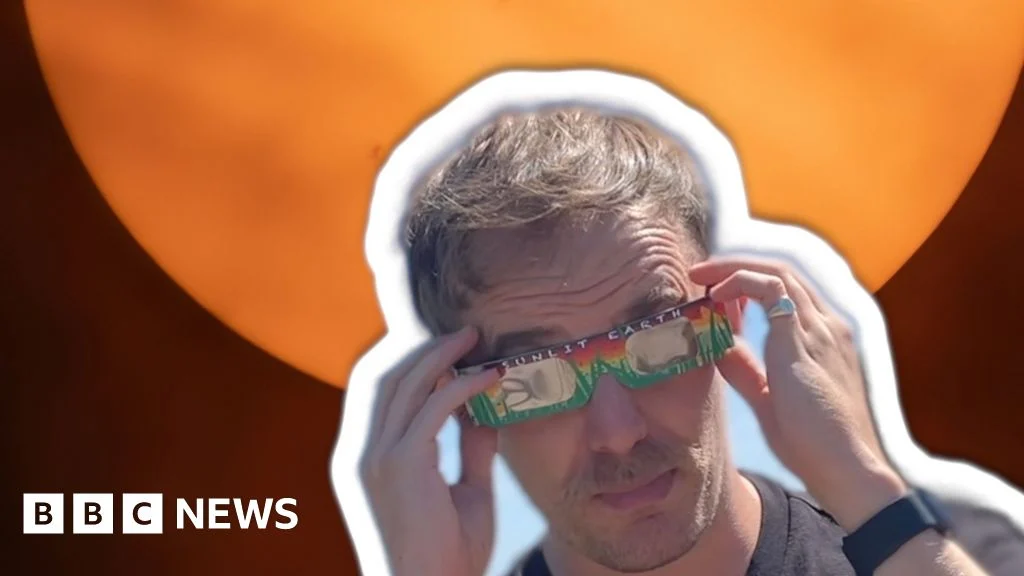
A celestial spectacle, a partial solar eclipse, is poised to captivate observers across the South West and Channel Islands on Wednesday evening. This rare astronomical event offers residents of Guernsey a unique opportunity to witness the Moon gracefully obscure a significant portion of the Sun, creating a memorable twilight display. The entire phenomenon is projected to unfold over approximately one hour and 50 minutes, commencing around 18:20 BST and concluding by 20:10 BST. Enthusiasts and casual observers alike from Guernsey are anticipated to experience an impressive 94% coverage of the Sun, making this an especially profound partial eclipse for the region. The next opportunity to witness a full solar eclipse from Guernsey will not arrive for another 55 years, specifically on 3 September 2081, underscoring the immediate significance of this upcoming event.
Understanding the mechanics of a solar eclipse is fundamental to appreciating its grandeur. A solar eclipse occurs when the Moon passes directly between the Sun and Earth, casting a shadow on our planet. From Guernsey’s vantage point, the alignment will not be perfect enough to produce a total solar eclipse, where the Moon completely blocks the Sun’s disk. Instead, the Moon will only cover a large fraction of the Sun, hence the classification as a partial eclipse. This means that while the Sun’s brilliant face will be significantly diminished, a crescent sliver will remain visible throughout the event. The precise geometry of the Earth-Moon-Sun system dictates whether an observer experiences a total, partial, or annular eclipse, with Guernsey positioned just outside the narrow path of totality for this particular celestial dance.
Crucially, the paramount concern for anyone planning to observe this partial solar eclipse is eye safety. Looking directly at the Sun, even when it is partially obscured, can cause severe and irreversible eye damage, including permanent blindness. The Sun’s harmful ultraviolet and infrared rays, along with its intense visible light, can burn the retina without causing immediate pain, leading to lasting vision impairment. Therefore, specialized eye protection is absolutely essential. Standard sunglasses, no matter how dark, are insufficient and unsafe for solar viewing. Approved methods for direct observation include certified solar eclipse glasses or viewers that meet the ISO 12312-2 international safety standard. These glasses feature specialized filters that block out nearly all harmful radiation, allowing for safe viewing of the Sun’s disk.
Beyond certified glasses, other safe viewing techniques exist. Pinhole projectors offer an indirect and safe way to observe the eclipse. This method involves creating a small hole in a piece of card and projecting the Sun’s image onto another surface. The image will show the crescent shape of the partially eclipsed Sun without requiring direct eye contact. For those with telescopes or binoculars, it is imperative to use only certified solar filters specifically designed to fit over the front of the objective lenses. Never use filters that attach to the eyepiece, as concentrated sunlight can still damage the filter and your eyes. Using unfiltered optical instruments to view the Sun is extremely dangerous and can cause instantaneous, severe eye damage. Public viewing events, if organized by local astronomy groups or scientific institutions, often provide safe viewing equipment and expert guidance, offering a communal and secure way to experience the eclipse.
For residents of Guernsey, optimizing the viewing experience involves selecting an appropriate location. Given that the eclipse culminates as the Sun begins its descent towards the horizon, a clear, unobstructed view to the west will be vital. Elevated positions such as the island’s coastal cliffs or hills could offer prime vantage points, allowing for an expansive vista of the western sky. Open fields or beaches also present excellent options, free from buildings or trees that might impede the view. Weather conditions will, of course, play a significant role. A clear sky is paramount for visibility. Should clouds obscure the view, dedicated live streams from locations with clearer skies will be available online, providing an alternative means to witness the event, albeit remotely. Photography of the eclipse also requires careful preparation. Specialized solar filters are necessary for camera lenses to protect both the camera’s sensor and the photographer’s eyes if using a through-the-lens viewfinder. A sturdy tripod and a telephoto lens will enhance the quality of photographs, capturing the intricate details of the Sun’s partially obscured disk.
The timeline of the eclipse offers specific moments of interest. The event begins at approximately 18:20 BST with "first contact," when the Moon first appears to touch the edge of the Sun. Over the next hour, the Moon will progressively cover more of the solar disk, reaching its maximum coverage of about 94% sometime around 19:15 BST. During this period of maximum eclipse, observers might notice a subtle dimming of the ambient light, an effect often likened to a late afternoon or early evening twilight, despite the actual time of day. The air temperature may also drop slightly. Following maximum coverage, the Moon will gradually recede from the Sun’s face until "last contact" at approximately 20:10 BST, when the Sun is fully uncovered once more, marking the end of the spectacle. The proximity of the eclipse’s end to sunset means that the remaining crescent of the Sun will be low in the sky, potentially enhancing its visual drama.
Eclipses have held profound cultural and scientific significance throughout human history. Ancient civilizations often viewed them with a mixture of awe, fear, and wonder, interpreting them as omens or divine interventions. Today, while our scientific understanding demystifies the phenomenon, the sense of awe persists. Solar eclipses have been crucial for scientific discovery, allowing astronomers to study the Sun’s faint outer atmosphere, the corona, which is usually hidden by the Sun’s overwhelming brightness. During a total eclipse, the corona becomes visible, revealing its intricate structure and dynamics. Even during a partial eclipse, observing the Sun’s diminishing light and the Moon’s silhouetted profile provides a tangible connection to the grand mechanics of our solar system.
The rarity of a total solar eclipse for Guernsey, with the next one not due until 2081, highlights the unique nature of this upcoming partial event. While a 94% partial eclipse is not a total eclipse, it is a very significant celestial alignment for the island. A total solar eclipse, a truly transformative experience, is characterized by the sudden darkness of midday, the shimmering corona, and the appearance of stars and planets. Though Guernsey will not experience this full totality on this occasion, witnessing nearly all of the Sun’s disk obscured by the Moon remains a powerful and unforgettable sight. The 2081 total eclipse will be a truly momentous occasion for future generations, making the current partial eclipse a valuable precursor and a moment to appreciate the regular, yet still spectacular, cosmic ballet.
Local astronomy enthusiasts and potentially community groups may organize informal viewing gatherings, fostering a sense of shared wonder. Checking local news outlets or community boards for any such initiatives could provide opportunities to view the eclipse with others who share an interest in astronomy. Even if no formal events are planned, the shared experience of looking up at the sky (safely!) connects individuals to a broader cosmic perspective. Documenting the event, through photography or simply journaling observations, can preserve the memory of this significant celestial occurrence.
Beyond the visual spectacle, the eclipse offers a moment to reflect on the precision of orbital mechanics. The Moon, at just the right distance and size relative to the Sun and Earth, creates these perfect alignments. This particular eclipse is a testament to the predictable, yet often surprising, motions within our solar system. While we won’t see the Sun’s corona from Guernsey during this partial eclipse, the event serves as a reminder of the dynamic nature of our star, constantly releasing energy and material into space, creating the solar wind and influencing space weather. The Moon’s silhouette moving across the Sun provides a direct visual representation of these cosmic forces at play.
In summary, the upcoming partial solar eclipse offers Guernsey a rare and visually striking astronomical event. It is an opportunity to connect with the cosmos, understand the intricate dance of celestial bodies, and marvel at the predictable yet awe-inspiring wonders of our solar system. Above all, prioritize safety by using certified solar eclipse glasses or indirect viewing methods. Prepare for the event by finding a clear westward view, checking weather forecasts, and noting the precise timings. This Wednesday evening promises a captivating display, a reminder of the grand universe beyond our island shores, and a unique chance to witness a significant celestial alignment before the next full solar eclipse graces Guernsey in over half a century.




 George Anjay
 Nakalama John
 atisusanti
 Ramos Leo