
 Nana Banana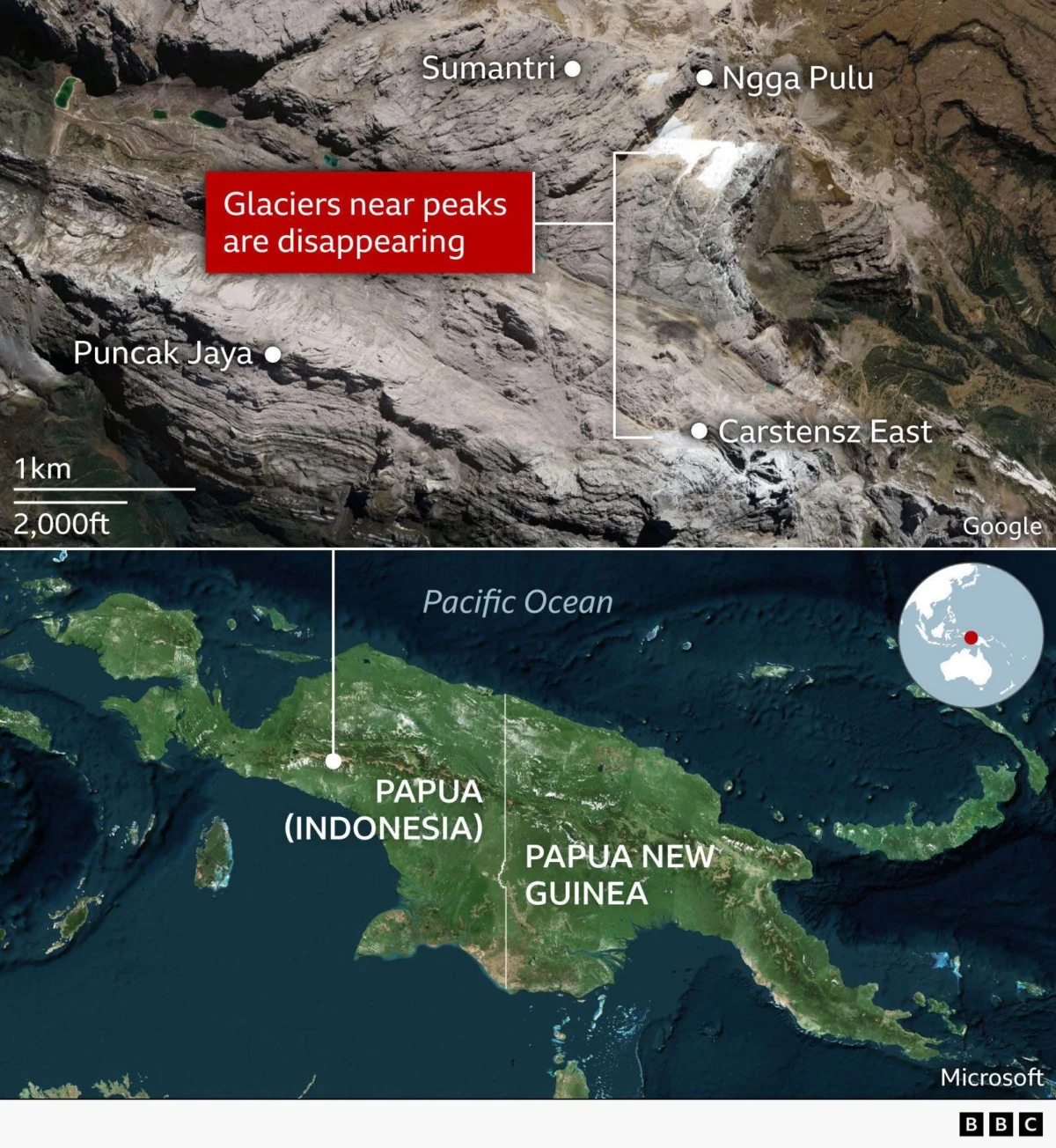
Nestled precariously close to the equator, the majestic peaks of Papua, Indonesia, have for centuries defied their tropical latitude, cradling what was once known as "eternal snow." These rare equatorial glaciers, perched atop the Sudirman Range on the world’s second-largest island, New Guinea, have long served as an extraordinary natural anomaly and a critical barometer of global climate health. However, this treasured natural wonder, a beacon of perpetual ice on a sun-drenched island, is now facing its imminent demise, with scientists predicting its complete disappearance within a mere year or two.
The highest point of this range, Puncak Jaya – also globally renowned as Carstensz Pyramid – stands at an impressive 4,884 meters (16,024 feet), distinguishing itself as the highest island peak in the world and one of the elusive "Seven Summits." Its unique position has rendered its glaciers invaluable to scientific inquiry, offering profound insights into the Earth’s intricate climate history. Beyond its scientific significance, Puncak Jaya holds an unparalleled spiritual reverence for many Indigenous Papuan communities, serving as the very epicenter of their cosmological and cultural universe – a sacred site akin to a Mecca or a Vatican, as poignantly described by a local activist.

A century ago, the approximately 300-kilometer (190-mile) stretch of the Sudirman Range boasted substantial snow and permanent ice across all four of its major peaks. Today, a stark and somber reality unfolds: only fragmented, diminishing patches of ice cling stubbornly to the slopes around Puncak Jaya. These last vestiges of tropical ice are expected to vanish entirely in the very near future, marking an irreversible loss. Historical data paints a grim picture of this rapid decline: glacier cover around Puncak Jaya has dramatically shrunk from an expansive nearly 1,900 hectares (4,700 acres) in the 19th Century to a mere 16 hectares (40 acres) today. This represents an astonishing rate of loss, with entire glaciers disappearing within the span of a single human lifetime, a testament to the accelerating pace of global warming.
"There is a profound unfairness in this," laments Marie Žabacká, a Czech glacier ecologist who embarked on a challenging expedition to Puncak Jaya last March. Her mission was to be among the last scientists to meticulously study Papua’s dwindling "eternal snow." She underscores the unparalleled uniqueness of these tropical glaciers, isolated by thousands of kilometers from any other major glacier systems. Papua, she notes, is home to the "last remaining tropical ice" situated between the vast Andes of South America and the towering Himalayas of Asia.
The scientific value of these glaciers cannot be overstated. Ice cores meticulously extracted from the slopes of Puncak Jaya function as invaluable natural archives, preserving a detailed, layered record of past climate conditions. By analyzing these ancient ice samples, scientists can reconstruct atmospheric conditions in the region over millennia, gaining critical information about historical temperatures, precipitation patterns, atmospheric composition, and even volcanic activity. This data is particularly crucial for understanding long-term changes in the planet’s warmest ocean waters that envelop the island – specifically, the dynamic tropical Pacific and the Western Pacific Warm Pool, which exert significant influence on global weather patterns. Tragically, this irreplaceable climate archive is vanishing at an alarming rate, far faster than scientists have been able to fully study and comprehend its profound secrets.

The retreat of Papua’s glaciers is not an isolated phenomenon; it is a localized manifestation of the same powerful, global forces that are impacting ice masses across the planet. Žabacká explains that the primary driver is a rapidly warming atmosphere, unequivocally caused by human activities, predominantly the relentless burning of fossil fuels such as coal, oil, and natural gas. As global temperatures steadily climb, the freezing point shifts progressively higher up mountain altitudes. This critical change means that more precipitation now falls as rain instead of snow, even in areas that historically received regular snowfall, further accelerating the melt.
Exacerbating this process are natural climate phenomena like El Niño events. During an El Niño, sea surface temperatures in the equatorial Pacific rise, which can lead to warmer air temperatures and reduced precipitation in the western Pacific, including New Guinea. This reduction in snowfall, combined with increased melting due to warmer conditions, creates a devastating feedback loop that rapidly diminishes the glacier mass. While global warming is the overarching cause, local factors such as specific cloud cover, snowfall variability, and mountain topography also play crucial roles in influencing the pace and pattern of this retreat.
The mountains in Papua, situated a mere 450 kilometers (280 miles) south of the equator, present an exceptionally delicate environment for ice survival. Here, "permanent ice can survive only at very high altitudes and within a narrow range of climatic conditions," Žabacká emphasizes. Consequently, even a fractional increase in temperature, a marginal elevation of the freezing point, or a slight shift from snowfall to rainfall can be the decisive factor determining whether a glacier can persist at all. The accelerating retreat of these glaciers provides irrefutable proof that the Earth has been warming over an extended period. Their impending disappearance signifies not only the loss of a unique biological habitat, home to specialized microbial life adapted to these extreme conditions, but also the destruction of an integral and profoundly significant cultural landscape.

For generations, at least five distinct Indigenous groups have maintained deep and intricate spiritual ties to Puncak Jaya. The Moni people, for instance, refer to the sacred peak as Mbainggela, believing it to be the ancestral dwelling where their forebears vigilantly watch over them. For the Amungme people, the entire range is known as Nemangkawi, or the "White Arrow." Elfrida Natkime, a young Amungme woman, shares the profound meaning behind this name: "Parents and grandparents prayed their children would have hearts like the White Arrow, never straying from the proper path. It symbolizes honesty, purity, and moral integrity." According to traditional Amungme beliefs, Nemangkawi embodies the very principles by which people should live their lives, guiding their ethical framework and cultural practices.
Amungme environmental activist Adolfina Kum articulates the immense spiritual importance of the peak to her people and the catastrophic implications for their traditions and cultural foundations as the ice melts. Her words resonate with deep emotion: "How would Muslims feel if Mecca were destroyed? How would Catholics feel if Rome or the Vatican were destroyed? For the Amungme people, that is what it feels like when Nemangkawi is destroyed." The vanishing ice is not merely an ecological crisis; it is an existential threat to their cultural identity, their historical narratives, and their collective soul. The sacred mountain, once a constant, eternal presence, is fading, taking with it generations of spiritual connection and traditional wisdom.
For many Indigenous Papuans, the disappearance of the glacier is not an isolated incident but rather another painful chapter in a long history of environmental and cultural disruption. The discovery of vast copper and gold deposits in the region during the 20th Century triggered a transformative and often tumultuous period. The subsequent development of massive extractive industrial projects, most notably the Grasberg mine, one of the world’s largest gold and copper operations, has irrevocably reshaped significant portions of the landscape. Entire mountain faces have been excavated, and surrounding valleys have been dramatically altered by the construction of roads, extensive industrial infrastructure, and new settlements.

While these developments have undeniably brought some benefits, such as jobs, improved roads, educational opportunities, and economic growth for some, they have also been accompanied by widespread environmental degradation and decades of social conflict. Many Indigenous communities have tragically lost access to their ancestral lands as mining operations expanded, leading to displacement and profound cultural dislocation. The BBC approached Freeport, the operator of the Grasberg mine, for comment on these impacts. Elfrida Natkime encapsulates this complex duality: "Every time I see the mountains, I feel amazed, but I also feel sadness. Since the company came, I have seen the exploitation. But the development has also provided a livelihood for many people." This sentiment reflects the difficult choices and profound changes imposed on Indigenous communities caught between tradition and modern development.
As local communities bear witness to the irreversible transformation of their sacred landscapes, a race against time is underway for scientists and explorers to meticulously document what precious little remains. Danish researcher Klaus Thymann, through his initiative Project Pressure, leads a dedicated team employing cutting-edge technologies. Using advanced drones and sophisticated three-dimensional mapping techniques, they have painstakingly created a detailed and comprehensive model of the current state of the remaining ice. Thymann reports a staggering statistic: from the early 2000s to 2025, the glaciated area has receded by an astonishing 95%. "There’s almost no ice left. Those are the facts," he states with stark clarity.
Thymann emphasizes the "incredibly powerful" role of glaciers as unambiguous indicators of climate change. "When people hear that something described as ‘eternal’ is disappearing, it triggers a reaction," he explains, highlighting the evocative power of this loss to raise global awareness. These detailed photographic and spatial records will serve as vital documentation for future scientific research, historical understanding, and public education, providing a stark visual testament to the rapid environmental changes occurring globally.

Adolfina Kum’s analogy powerfully concludes the narrative of cultural loss: she believes communities "lose an important source of strength" whenever sacred mountains, ancient forests, or ancestral places are disturbed. "I often describe it as pulling out the roots of a tree. Once the roots are removed, the tree loses its foundation." The impending disappearance of Papua’s ‘eternal snow’ on Puncak Jaya represents not just an ecological catastrophe, but a profound cultural wound, severing a vital link to the past, present, and future for the Indigenous peoples who call this sacred landscape home. It stands as a stark, icy monument to the global climate crisis, a poignant reminder of what we stand to lose, both scientifically and culturally, if urgent action is not taken.


 Roy Suryo




 Nakalama John