George Anjay
More than 160 people have been injured, some critically, in Iranian missile strikes that targeted two southern Israeli towns, Arad and Dimona, on Saturday evening, according to Israeli emergency officials. The attacks, which involved ballistic missiles, wounded 84 individuals in Arad and 78 in Dimona. While the International Atomic Energy Agency (IAEA) has stated it is unaware of any damage to the nuclear research facility located approximately 13 kilometers (8 miles) outside Dimona, Iranian state television has claimed responsibility, asserting the strikes were a direct response to an earlier attack on Iran’s Natanz nuclear facility on Saturday. Adding to the escalating tensions, emergency services reported that at least seven people were injured in a separate Iranian missile attack on Tel Aviv on Sunday.
The Israeli Air Force has indicated that Tehran has launched a significant barrage of 400 missiles at Israel since the commencement of hostilities on February 28th, following a US-Israeli strike on Iran. Of these projectiles, the IAF claims an impressive 92% were intercepted, highlighting the sophistication of Israel’s aerial defense systems. However, the recent attacks underscore that these defenses are not infallible.
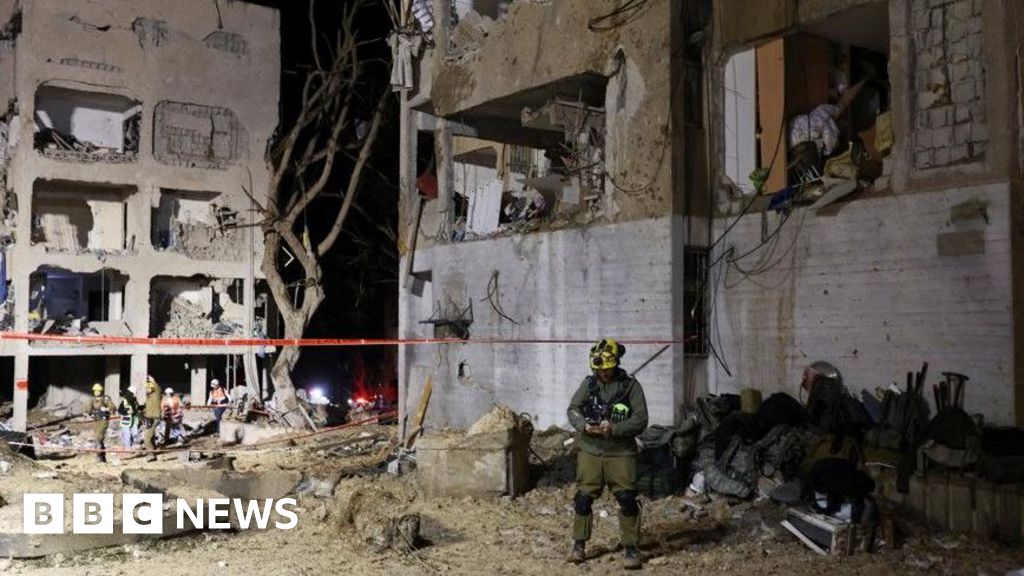
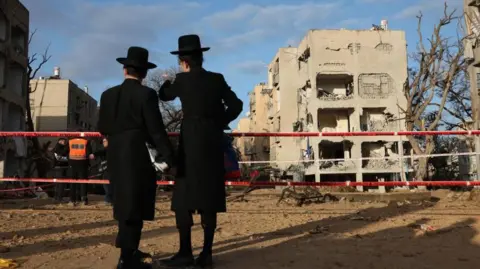
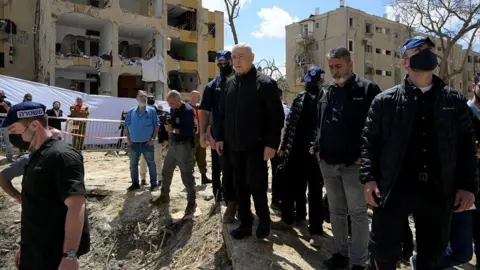
In Arad, residents described the missile impacts on Saturday evening as "terrifying." The destructive force of a large Iranian missile shattered apartment blocks, leaving a deep crater and causing extensive damage. Naram Zaid, a paramedic who responded to the scene in Arad, recounted the harrowing aftermath, telling BBC News that she witnessed "a lot of children with head and chest injuries" who had been trapped by debris within damaged buildings. "I was trying to reassure a 10-year-old girl with head injuries, with blood on her face from broken glass," she added. "She was refusing to get into the ambulance as her parents were still inside the building, and we waited for her parents to be evacuated from the destroyed apartment block and then we sent them all to hospital." The physical devastation was stark, with the outer walls of two residential apartment buildings visibly gouged out by the force of the explosions. In this predominantly Ultra-Orthodox town in the Negev desert, crowds of men in dark suits stood in stunned silence, surveying the wreckage.
The nearby town of Dimona experienced a similar missile strike, with a 10-year-old boy among the seriously injured. Israeli firefighters confirmed that in both Dimona and Arad, "interceptors were launched that failed to hit the threats, resulting in two direct hits by ballistic missiles with warheads weighing hundreds of kilograms." The gravity of these attacks was underscored by the visits of both Israeli Prime Minister Benjamin Netanyahu and President Isaac Herzog to the impacted sites on Sunday. Prime Minister Netanyahu was seen inspecting the damage in Arad, a somber visual testament to the ongoing conflict.
The ability of Iran to consistently inflict damage within Israel serves as a stark reminder of the profound human cost of this escalating war. Urgent investigations are underway to determine how these particular missiles managed to breach Israel’s sophisticated air defense network. However, as was evident during the 12-day war last summer, the system, while highly advanced, is not impregnable. Such persistent attacks, rather than weakening Israeli resolve, are likely to further harden public determination to confront the threat.
The Shimon Peres Negev Nuclear Research Center, colloquially known as the "Dimona reactor," is situated in the Negev desert and is widely understood to house Israel’s undeclared nuclear weapons arsenal. For decades, it has been an open secret that Israel developed nuclear capabilities at this site, although successive governments have maintained a deliberate policy of ambiguity regarding its nuclear status. This makes Israel the sole nuclear power in the Middle East, and any perceived threat to this facility or its environs is treated with the utmost gravity.
Both Israel and the United States have consistently identified the elimination of any potential Iranian capacity to develop nuclear weapons as a paramount objective of the ongoing conflict. Iran’s Atomic Energy Organization, in response to the attack on Natanz, denounced it as a violation of the Treaty on the Non-Proliferation of Nuclear Weapons. However, they also stated that "no leakage of radioactive materials" was reported and that there was "no danger to residents of the surrounding areas." It is worth noting that Natanz has been a target in earlier phases of the conflict, including US-Israeli strikes at the outset of the war on February 28th and during the 12-day war last June. When questioned about Natanz on Saturday, the Israel Defense Forces maintained that they were unaware of any strike in the area.
The ongoing exchange of missile fire and the resulting casualties highlight the volatile nature of the conflict and the significant risks posed to civilian populations on both sides. The international community continues to monitor the situation with deep concern, as the specter of a wider regional conflagration looms large. The effectiveness of missile defense systems, the strategic implications of targeting nuclear facilities, and the humanitarian consequences of prolonged warfare remain critical focal points as the conflict unfolds.
Additional reporting by Tom Bennett and Gabriela Pomeroy.




 Nakalama John
 Ramos Leo
 Nana Banana