George Anjay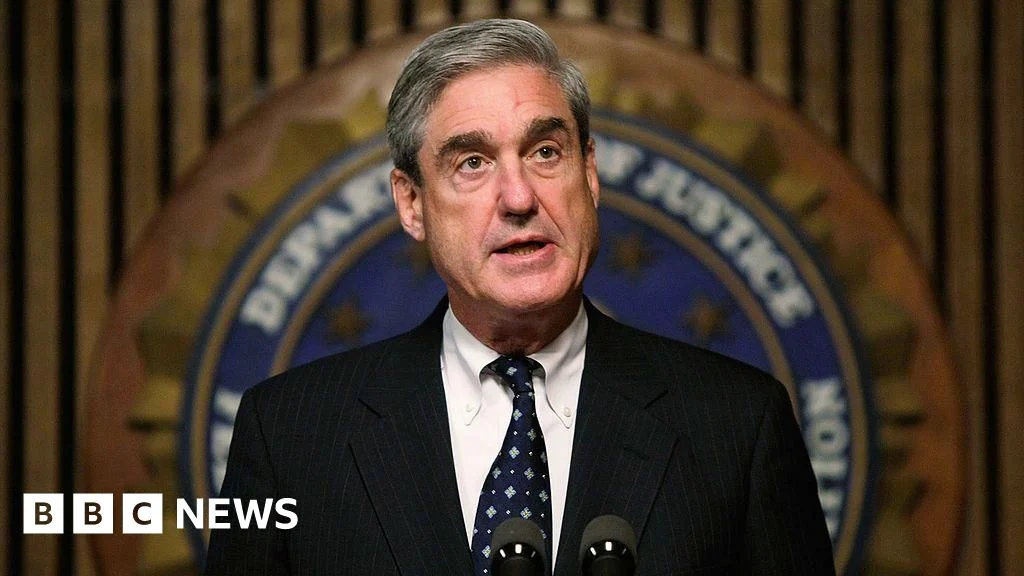
Robert Mueller, the formidable former FBI director whose tenure was defined by his stoic leadership through national crises and, most notably, his painstaking investigation into Russian interference in the 2016 US election, has died at the age of 81. His passing marks the end of a distinguished career in public service that spanned decades, characterized by an unwavering commitment to justice and the rule of law. The cause of his death was not immediately disclosed, though CBS News, the BBC’s US partner, confirmed the tragic news.
"With deep sadness, we are sharing the news that Bob passed away" on Friday night, his family conveyed in a statement to the Associated Press, requesting privacy. Mueller’s impact resonated deeply within law enforcement and political circles, drawing poignant tributes from those who knew and served alongside him.
Mueller’s leadership at the Federal Bureau of Investigation (FBI) from 2001 to 2013 was nothing short of transformative. He took the helm just days before the devastating September 11th terrorist attacks, a pivotal moment that reshaped the agency’s mission and his own responsibilities. Under his guidance, the FBI was reoriented and strengthened as a formidable counterterrorism force, a critical adaptation in the face of evolving global threats. His stewardship of the agency during this tumultuous period was widely lauded for its steady hand and strategic foresight.
He is survived by his wife of nearly 60 years, Ann Cabell Standish, their two daughters, and three grandchildren, a testament to a life lived both in public service and private devotion.
The special counsel inquiry into Russian interference in the 2016 presidential election, a probe that cast a long shadow over Donald Trump’s first term, brought Mueller into an intensely scrutinized spotlight. The investigation, launched in May 2017, meticulously examined the extent of Russian efforts to influence the election and whether members of the Trump campaign had colluded or coordinated with these foreign actors. The findings of this investigation, detailed in a comprehensive report, became a focal point of political debate and intense media coverage for nearly two years, concluding in March 2019.
Former President Donald Trump, who consistently characterized the investigation as a "witch hunt" and a "hoax," reacted to the news on his social media platform, Truth Social, with a venomous statement: "I’m glad he’s dead. He can no longer hurt innocent people!" This starkly contrasted with the widespread respect and admiration expressed by many of Mueller’s former colleagues and employers.
Tributes from figures across the political spectrum underscored Mueller’s reputation as a dedicated public servant. George W. Bush, who appointed Mueller as FBI director, expressed his profound sorrow. "In 2001, only one week into the job as the sixth director of the FBI, Bob transitioned the agency mission to protecting the homeland after September 11," Bush stated. "He led the agency effectively, helping prevent another terrorist attack on US soil."
Barack Obama, who served as president during the latter part of Mueller’s FBI tenure, lauded him as "one of the finest directors in the history of the FBI," commending his "relentless commitment to the rule of law and his unwavering belief in our bedrock values."
James Comey, who succeeded Mueller as FBI director and whose subsequent dismissal by President Trump precipitated the appointment of the special counsel, shared his personal grief: "A great American died today, one I was lucky enough to learn from and stand beside." A spokesman for Mueller’s former law firm, WilmerHale, described him as an "extraordinary leader and public servant and a person of the greatest integrity."
Born in 1944, Mueller’s path to public service began with a distinguished military career. After graduating from Princeton University with a degree in politics, he enlisted in the Marines. His service in Vietnam in 1968 saw him deployed as a lieutenant leading a platoon of troops. He was wounded twice in combat and received numerous commendations, including the Bronze Star for valor and a Purple Heart, reflecting his courage and sacrifice.
Upon his return from the war, Mueller pursued legal studies at the University of Virginia, earning his law degree in 1973. His legal career paved the way for his entry into federal law enforcement.
His confirmation as FBI director in August 2001, with unanimous support from the US Senate, marked a significant milestone. He would go on to serve for over a decade, an unusually long tenure for an FBI director, a testament to his effectiveness and the trust placed in him. He retired from the FBI in 2013, but his period of public service was far from over.
Four years later, Mueller was called back into the public arena for what would become his most defining role. The political climate in Washington was charged, and the appointment of a special counsel to investigate the 2016 election was a highly sensitive and consequential decision. Mueller’s investigation was characterized by its methodical approach and the intense scrutiny it generated. The court filings from his special counsel’s office were dissected daily, with each revelation fueling speculation and intense debate about its potential implications.
President Trump’s consistent denunciation of the investigation as a "witch hunt" underscored the deep divisions it exposed. Trump frequently asserted that there had been "no collusion" between his campaign and Russia, a central tenet of his defense throughout the inquiry. Despite the intense public focus, Mueller himself remained largely out of the public eye, allowing the evidence and findings of his team to speak for themselves.
Andrew Weissmann, a member of Mueller’s team, offered a personal reflection on the investigation and its leader: "I did not always agree with everything that Robert Mueller did. I think it’s really important for people to know how much integrity and how much thoughtfulness went into his decision-making and how much faith he had – maybe more than I did – in the American people, in citizens and in Congress."
The investigation resulted in multiple indictments and plea deals for key figures connected to the Trump campaign, including former campaign manager Paul Manafort and national security adviser Michael Flynn. These legal proceedings further intensified the political drama surrounding the probe.
The culmination of the investigation was the 448-page "Mueller Report." While it definitively found that Russia had interfered in the 2016 election in a "sweeping and systemic fashion," it did not establish that members of the Trump campaign conspired or co-ordinated with the Russian government in these efforts. Crucially, the report stated, "while this report does not conclude that the president committed a crime, it also does not exonerate him," a nuanced finding that fueled continued debate and legal scrutiny.
In February 2021, Mueller granted a rare interview to MSNBC, reflecting on pivotal moments in his extensive career. When asked about his decision to undertake the politically fraught special counsel investigation, he explained, "I found that I’ve gotten tremendous enjoyment out of public service. And I find it hard to turn down a challenging assignment." This statement encapsulates the core of his public service ethos: a quiet dedication to duty and a willingness to tackle difficult tasks, even in the face of immense pressure and controversy. Robert Mueller’s legacy is that of a man who navigated some of the most challenging periods in American political history with a steady hand, an unyielding commitment to his principles, and a deep respect for the institutions he served.


 Nakalama John
 Ramos Leo
 Nana Banana