Ramos Leo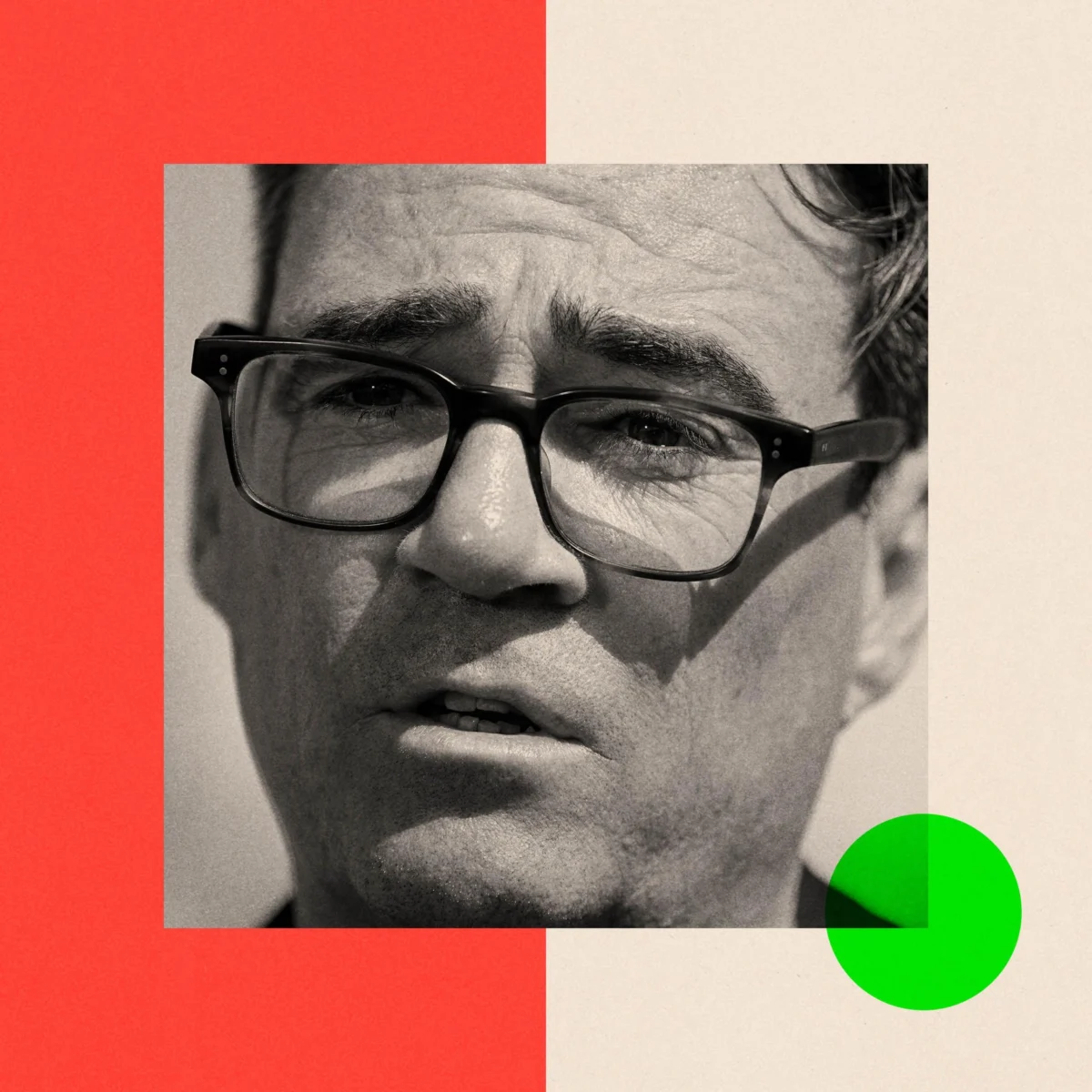
The political landscape in the United Kingdom has shifted noticeably in the wake of Andy Burnham’s ascent to Prime Minister, a fortnight ago. As Professor of Politics at the University of Strathclyde and a Senior Fellow at the National Centre for Social Research and The UK in a Changing Europe, Sir John Curtice offers a meticulous analysis of the recent polling data and electoral outcomes, confirming what many have dubbed the "Burnham bounce" for the Labour Party. This uplift has been concretely underscored by Labour’s convincing victory in Thursday’s Greater Manchester Mayoral by-election, providing tangible evidence beyond mere opinion polls.
Opinion polls conducted over the past week consistently place Labour’s support, on average, in the mid-20s. This marks the party’s highest standing since the beginning of last year and represents a significant improvement from their 19% rating in late June, when Sir Keir Starmer announced his resignation as leader. Sir Keir’s departure came amid growing dissatisfaction with his leadership and the party’s consistent struggle in the polls, prompting a leadership contest that ultimately saw Burnham emerge unopposed. While the current boost is welcomed by Labour, Sir John Curtice cautions that the party still faces a formidable challenge before it can confidently approach a general election. Reform UK, a resurgent force in British politics, is polling only narrowly behind Labour, indicating a highly competitive and fragmented electoral environment.
The phenomenon of a "new PM effect" is far from unprecedented in British politics. Historically, most mid-term changes of prime minister have been followed by an increase in the popularity of the incumbent government. For instance, Labour experienced a seven-point surge in support after Gordon Brown took over from Tony Blair in 2007. Similarly, the Conservatives enjoyed a six-point bounce when Boris Johnson replaced Theresa May in 2019. These upticks are often attributed to a "honeymoon period," where a new leader benefits from a fresh start, increased media attention, and a public desire for change. The exception to this trend was Liz Truss’s brief tenure in 2022, whose arrival in Downing Street was swiftly overshadowed by the death of Queen Elizabeth II and an immediate economic crisis, failing to generate any meaningful boost for her party.

It is crucial to consider the depth of the electoral hole that Andy Burnham inherited as Labour leader. The 19% poll rating at which Labour stood when Sir Keir Starmer resigned was the lowest handed down by any prime minister departing mid-term. This was even lower than the 23% bequeathed by Liz Truss, despite her exceptionally short 45 days in office. Against such a dismal backdrop, it would have been highly surprising if the replacement of the deeply unpopular Sir Keir with the relatively popular Burnham had not provided Labour with some form of short-term boost. However, even after this "Burnham bounce," Labour’s current poll average remains the lowest for any newly minted mid-term prime minister. Furthermore, the party is still considerably adrift from the (already relatively low) 35% share of the vote it secured in the 2024 general election, underscoring that while the bounce is real, it is indeed "not massive."
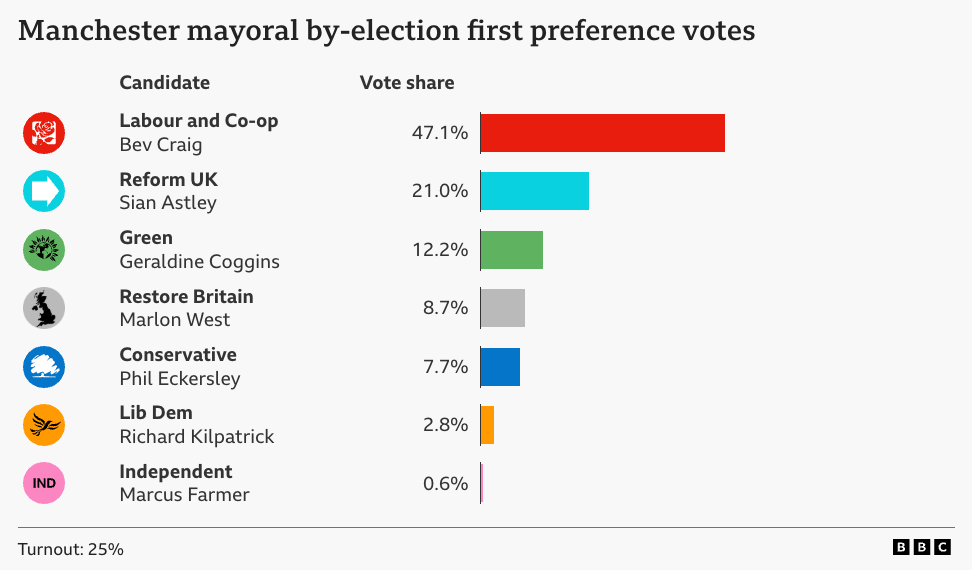
Labour’s convincing victory in Thursday’s Greater Manchester Mayoral by-election offers a more granular perspective on the "Burnham bounce." While Labour’s 47% share of the first preference vote was a decrease from the 63% Andy Burnham secured in the last mayoral contest, which occurred shortly before the 2024 general election, it still represented a near doubling of the 24% Labour registered across the region in May’s local elections. More significantly, it was even four points up on Labour’s local tally in the 2024 general election. This performance was notably better than what would have been anticipated from even the latest national polling averages, suggesting a localized surge of support perhaps intensified by the change in national leadership.
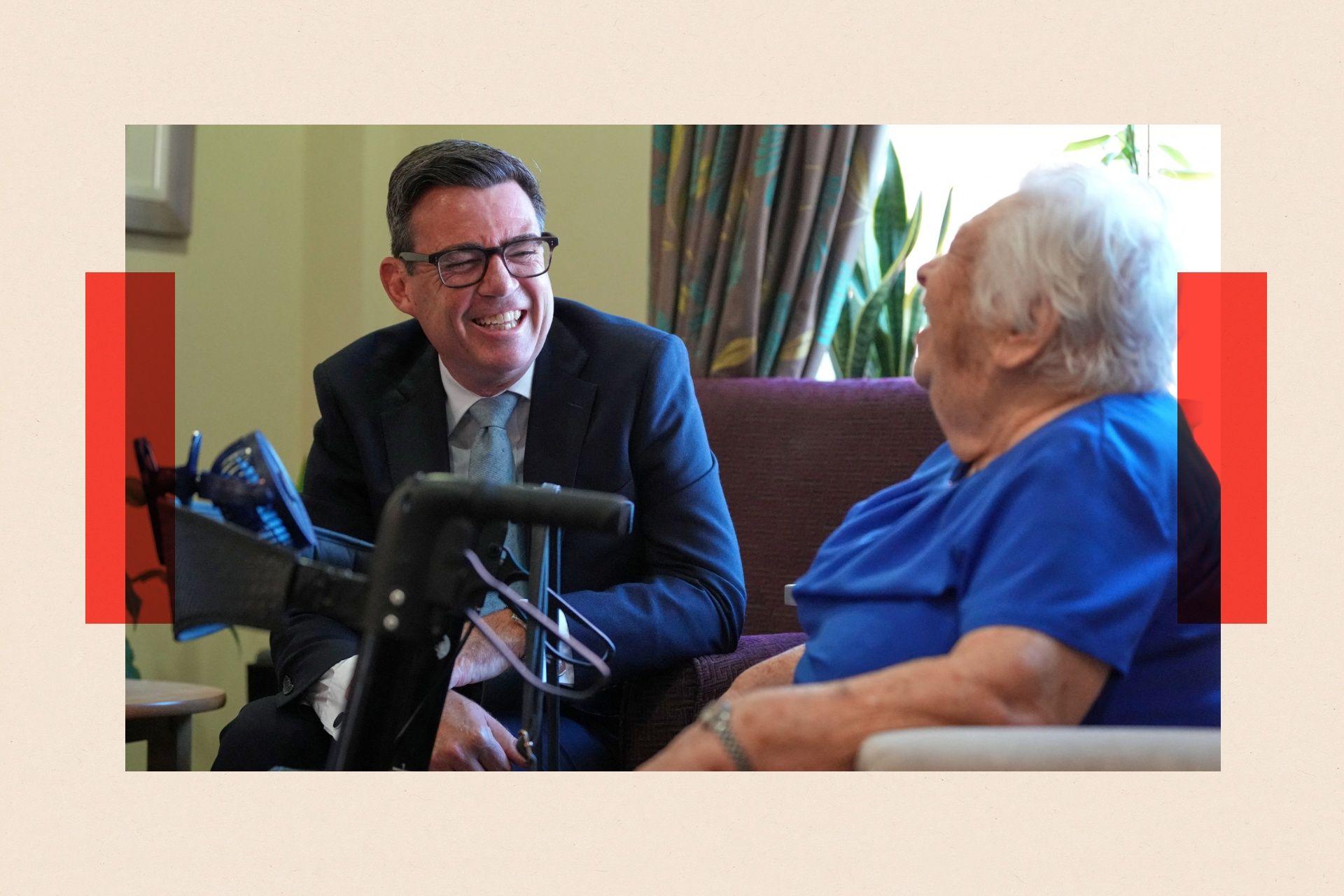
Despite these positive signs, Labour’s narrow lead over Reform UK explains why Burnham has wisely ruled out an early general election. Indeed, Reform’s displacement from first place in the polls for the first time in over a year appears to owe as much, if not more, to its own internal difficulties than to Labour’s newfound popularity. Reform UK has faced a turbulent period in recent weeks, plagued by questions surrounding the legality of some of its funding sources and allegations regarding whether Nigel Farage should have declared certain funding to the Commons’ authorities before his election as an MP. In response to these allegations, Farage announced on 7 July that he would be standing down and seeking re-election in his Clacton constituency in a by-election scheduled for 13 August.
This strategic move by Farage appears to have backfired. Immediately prior to his announcement, Reform’s average poll rating stood at 27%. In the polls conducted in the immediate aftermath, it plummeted by three points to 24%, a level at which it currently stands, marking its lowest point in 15 months. Concurrently, Farage’s personal approval ratings have reached their lowest ebb since his return as Reform’s leader during the 2024 election campaign. In the Manchester by-election, Reform’s share of the first preference vote was nine points down on its regional tally in May’s local elections. As observed in the Makerfield by-election, the party seemingly suffered from the emergence and advance of Rupert Lowe’s breakaway faction, Restore Britain, which garnered nearly 9% of the Manchester vote, notably outpolling the Conservatives in the process. Without Reform’s self-inflicted difficulties and the splintering of the right-wing vote, the "Burnham bounce" alone would likely have been insufficient to put Labour in the lead in the national polls.
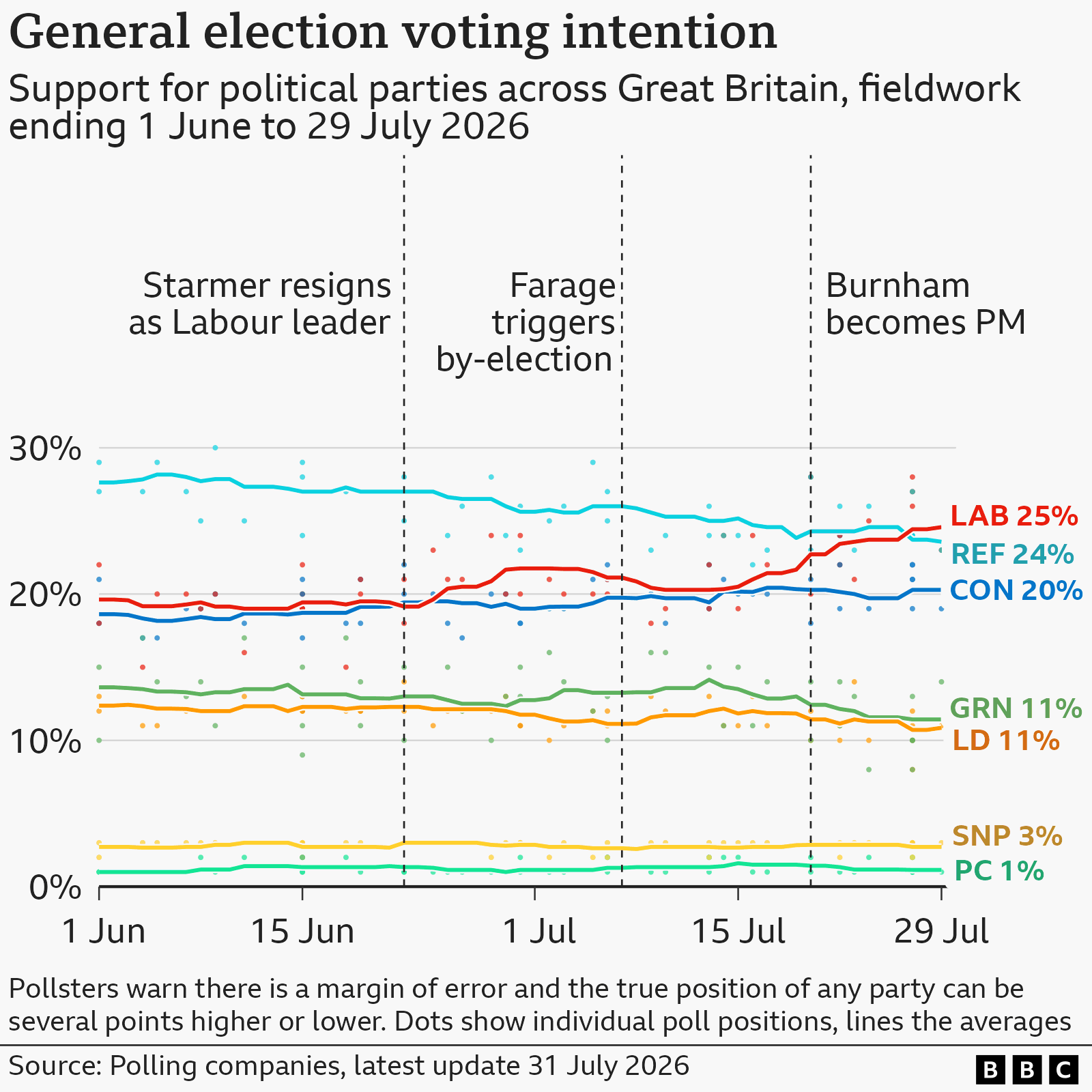
The principal source of Labour’s bounce has been its success in clawing back voters from the Greens and the Liberal Democrats, both of whom have experienced a two-point drop in support since Burnham’s uncontested victory in the Labour leadership contest. For the Green Party, in particular, the change of prime minister has proven especially damaging. Much of their increased support in recent months had come from disillusioned Labour voters who had backed the party in the 2024 general election. The Greens’ current 11% tally is a significant four points adrift of where it stood when Sir Keir Starmer announced his departure. Specifically, when Sir Keir resigned, 14% of Labour’s 2024 election voters indicated they would now back the Greens; that figure has now dropped to 9%.
This trend of winning back former Labour voters has been a key component of the "Burnham bounce." Overall, 67% of those who voted Labour in 2024 now state they would vote for the party, a notable increase from the 57% who expressed this sentiment when Sir Keir Starmer indicated he was leaving Downing Street. Following Farage’s difficulties, Labour is also now losing fewer of its 2024 voters to Reform. Intriguingly, the same is true for the Conservatives, whose loss of support to Reform in the polls throughout this parliament has always been significantly greater than that suffered by Labour. Far from suffering from a "Burnham bounce," Kemi Badenoch’s Conservative party has actually edged up to 20% in the polls for the first time since last spring, suggesting a degree of stabilization, albeit from a low base.
Andy Burnham’s arrival has undoubtedly injected new hope into the Labour Party. However, despite having now overtaken Reform UK in the national polls, the new Labour leader still faces the arduous task of proving he can genuinely win back the working-class, pro-Brexit voters who once formed Labour’s core constituency but now largely constitute the heart of Reform’s support base. To achieve this, and to put Labour on a credible course for victory in a general election, potentially in 2029, Burnham must deliver on the substantial policy challenges confronting his government. These challenges remain as formidable as those that plagued Sir Keir Starmer’s leadership. Ultimately, Labour’s long-term prospects at the next general election will hinge not just on a temporary popularity surge, but on whether voters come to believe that the promises he has made are actually being translated into tangible, positive change.


 atisusanti
 Nana Banana
 George Anjay
 Nakalama John