George Anjay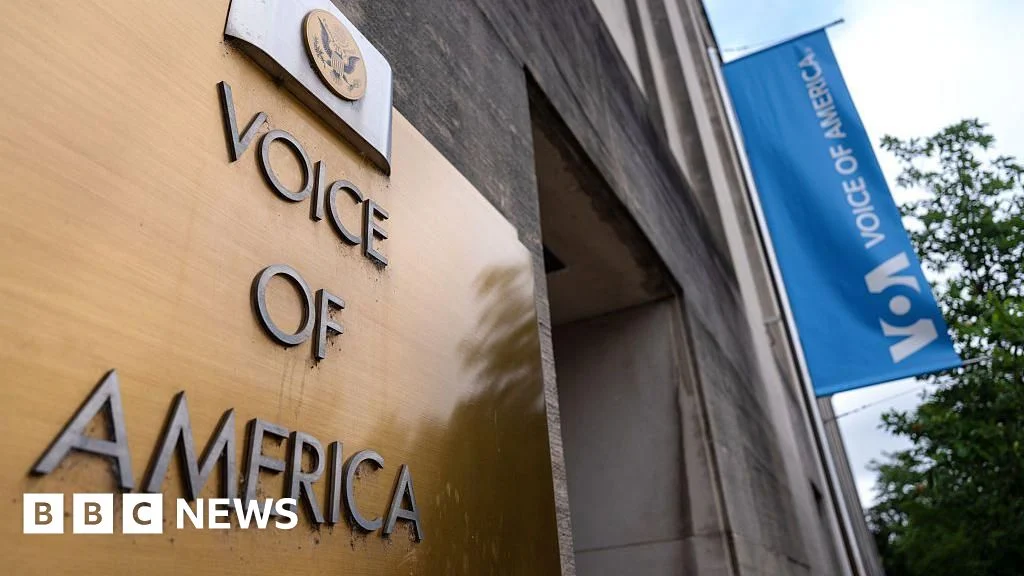
In a significant rebuke to the previous Trump administration’s approach to international broadcasting, a US federal judge has declared the effective closure of the Voice of America (VOA) and the dismissal of hundreds of its journalists last year as "illegal." District Court Judge Royce Lamberth has mandated that the international broadcaster must be restored to full operation within a strict one-week deadline, a ruling that has sent reverberations through the halls of government and the media landscape.
The Voice of America, a venerable institution established during the existential threat of World War Two, was originally conceived as a crucial tool to counter the insidious propaganda of Nazi Germany. Its mission has historically been to provide objective news and information to audiences around the globe, fostering understanding and democratic values. However, just weeks after his return to the presidency, Donald Trump issued an executive order aimed at dismantling the agency, citing accusations of "left-wing bias" within its reporting. This directive also extended to other U.S.-funded international broadcasters, including Radio Free Europe and Radio Free Asia, with orders to be "eliminated to the maximum extent consistent with applicable law."
In furtherance of this agenda, President Trump appointed Kari Lake to lead the U.S. Agency for Global Media (USAGM), the umbrella organization responsible for overseeing and funding the VOA, Radio Free Europe, and Radio Free Asia. Under Lake’s leadership, a sweeping purge of personnel ensued, resulting in the termination of over 85% of the agency’s employees. This translated to the dismissal of more than 1,000 staff members at the VOA alone, leaving only a skeletal crew to maintain operations. Many of these displaced journalists have been on paid administrative leave since the previous year, a situation that highlighted the precariousness of their positions. Notably, Persian Service reporters were recalled to their duties only after a significant geopolitical event – Israel’s attack on Iran in June of the preceding year – underscoring the complex and often politically charged environment in which these broadcasters operate.
The legal challenge that led to Judge Lamberth’s decisive ruling began with a lawsuit filed by three VOA journalists who contested the administration’s actions. Last week, Judge Lamberth had already established a critical precedent by ruling that Kari Lake lacked the legal authority to order the suspension of the USAGM workforce because her appointment had not received confirmation from the U.S. Senate. This prior ruling laid the groundwork for Tuesday’s more comprehensive judgment.
In his latest order, the federal judge characterized the mass dismissals of journalists as "arbitrary and capricious." He further elaborated that the government had demonstrably failed to consider existing legislation that specifically outlines the languages and regions that the Voice of America is mandated to serve. This failure to adhere to statutory requirements formed a central pillar of the judge’s decision, emphasizing that administrative actions must be grounded in legal frameworks.
"Defendants have provided nothing approaching a principled basis for their decision," Lamberth wrote in his scathing assessment of the administration’s actions. This statement directly challenges the justifications presented by the Trump administration for its drastic measures, suggesting a lack of substantive reasoning and a potential disregard for due process.
Patsy Widakuswara, one of the three VOA journalists who brought the lawsuit, expressed profound gratitude for the judge’s decision. "We hope the American people will continue to support our mission to produce journalism, not propaganda," she stated to the Associated Press news agency, a sentiment that encapsulates the core mission of the VOA and the concerns of its journalists regarding the politicization of their work. This statement underscores the perceived threat to journalistic integrity and the commitment to objective reporting that the VOA aims to uphold.
The future of the agency’s leadership remains somewhat uncertain, as it is not yet clear whether Kari Lake’s nominated successor, Sarah Rogers, whose appointment also requires Senate confirmation, will choose to appeal the judge’s ruling. The potential for further legal battles hangs in the balance, dependent on the decisions made by the incoming administration and the Senate’s confirmation process.
Before its effective winding down, the Voice of America played a significant role in global information dissemination, broadcasting television, radio, and digital content in nearly 50 languages. This extensive reach highlights the impact of its operations and the vacuum left by its curtailment. The agency’s programming aimed to provide diverse perspectives and reliable news to audiences who may have limited access to independent media.
Donald Trump’s criticisms of the Voice of America are indicative of his broader pattern of challenging and attacking the U.S. media landscape. Numerous studies have suggested that American news consumers perceive the media as increasingly polarized, and the administration’s actions against state-funded broadcasters have been interpreted by some as further contributing to this fragmentation and distrust. The VOA, by its very nature as a government-funded entity, has always navigated a delicate balance between serving national interests and maintaining journalistic independence, a challenge that the previous administration’s actions appeared to exacerbate. The judge’s ruling, therefore, not only reinstates a critical voice in international broadcasting but also serves as a judicial check on executive power and a reaffirmation of legal processes in the realm of media operations. The implications of this decision extend beyond the immediate reinstatement of journalists; they touch upon the fundamental principles of free press, governmental accountability, and the role of American international broadcasting in a globalized world. The swift compliance with the judge’s order will be closely watched as a measure of the administration’s commitment to respecting judicial mandates and upholding the integrity of institutions tasked with informing the world.



 Nakalama John
 Ramos Leo
 Nana Banana