atisusanti
The financial landscape for major US technology firms is experiencing a significant downturn, marked by sharp declines in stock values for the second consecutive day. This precipitous fall is largely attributed to escalating investor anxieties surrounding the colossal sums being poured into artificial intelligence (AI) development and infrastructure. Companies are collectively committing to an unprecedented scale of investment, with projections indicating that global spending on AI could approach a staggering $1 trillion mark in the near future. This surge in AI expenditure, while signaling a transformative technological era, is now casting a shadow of doubt over the immediate profitability and long-term sustainability of these tech giants, prompting a widespread sell-off across the sector.
The tremors of investor apprehension were vividly illustrated by the dramatic 28% plunge in Intel’s stock on Friday. The semiconductor giant, a linchpin in the hardware necessary for AI computation, found itself at the epicenter of the market’s reaction. This significant depreciation followed a pattern of declines observed in other key players. Alphabet, the parent company of Google, continued its downward trajectory, shedding an additional 1.4% of its stock value. This latest dip came on the heels of a more substantial 12% fall experienced on Thursday, signaling a growing concern among investors about the financial implications of Google’s AI initiatives.
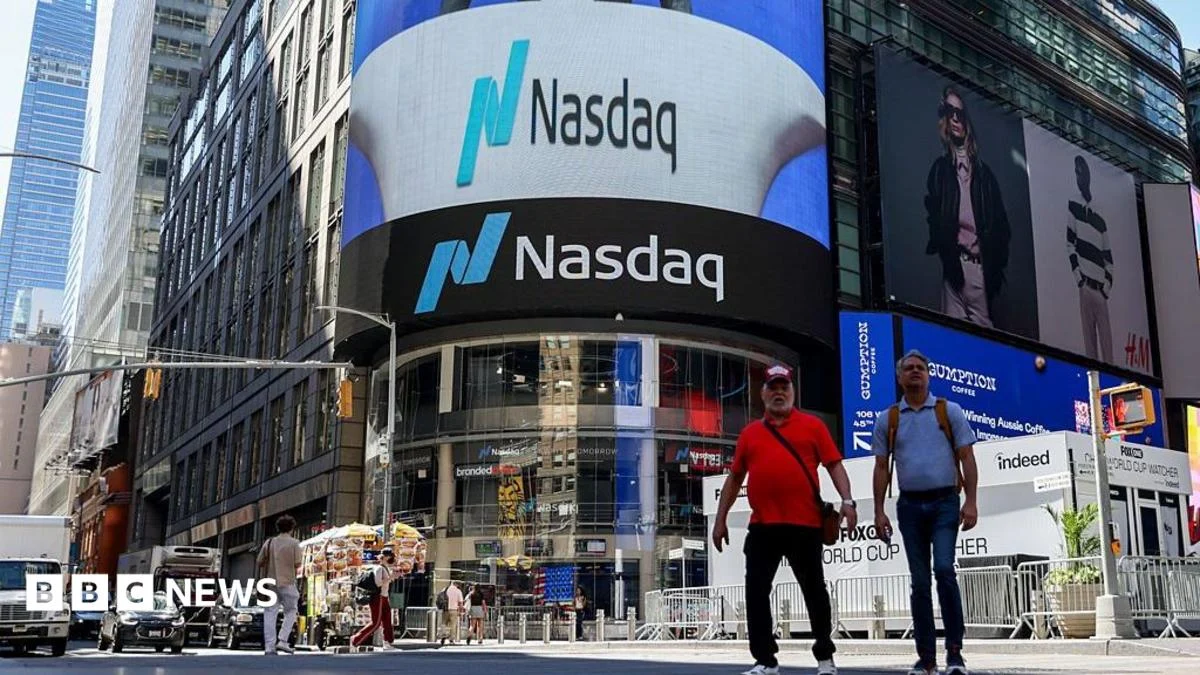
The broader tech market was not immune to this sentiment of unease. Other prominent tech stocks, including those of social media platform Reddit and e-commerce behemoth Amazon, also registered significant declines. The Nasdaq Composite Index, a barometer for the largest technology companies listed in the United States, concluded the month of October with its most significant monthly slide since March 2025, underscoring the pervasive nature of the market’s bearish sentiment towards the tech sector.
At the heart of this investor discontent lies a growing disconnect between the immense financial commitments to AI and the tangible returns they are generating. While tech firms are demonstrably accelerating their investments in AI, their reported earnings are, in many instances, falling short of analysts’ expectations. This discrepancy is fueling fears of an impending AI bubble, a scenario where the market valuations of AI-focused companies far exceed their intrinsic value, setting the stage for a potentially painful correction.
The scale of these AI investments is truly monumental. Major tech titans such as Meta, Alphabet, Oracle, Amazon, and Microsoft have collectively pledged to invest a colossal $800 billion by 2026. This figure represents a significant ramp-up in capital allocation, with companies prioritizing AI research, development, and the construction of vast data center infrastructures necessary to power these advanced systems.
Alphabet’s recent financial disclosures provided a stark example of the immediate impact of AI integration on established revenue streams. The company’s market value experienced a substantial hit of over $500 billion (£374 billion) on Thursday alone. This erosion of value was directly linked to the revelation that its new AI-powered search summaries, which now appear as the top answer to many user queries, were adversely affecting its core search advertising revenue. This suggests a complex interplay where the very innovation designed to enhance user experience might be cannibalizing a critical source of income. Furthermore, Alphabet anticipates spending up to $205 billion this year on investments, with a significant portion of this outlay exclusively dedicated to AI-related ventures.
While Alphabet’s decline was substantial, the losses experienced by Intel on Friday were even more pronounced, with the chip maker shedding more than $130 billion in market capitalization. Intel’s strategic decision to increase its spending on AI, even amidst a softening demand for personal computers – a traditional cornerstone of its micro-processor sales – has clearly unsettled investors. The company’s finance chief, David Zinsner, articulated the prevailing challenges in a recent earnings call, stating that Intel did not expect to achieve a cash surplus this year and forecasting lower-than-expected revenue for its fourth quarter. Zinsner cautioned that the slowdown in the personal computer market is anticipated to persist, at least through the first half of the upcoming year. He also highlighted a significant increase in capital expenditures on equipment during the third quarter, with further, even more substantial, investments planned for the subsequent three months.
Amazon, another tech behemoth, also reported financial results that underscored the immense capital expenditure associated with its AI ambitions. The e-commerce giant revealed that it had, in fact, spent more cash than it generated, with its spending escalating six-fold within a three-month period. The company has committed to an impressive $220 billion in spending this year, primarily directed towards critical AI infrastructure, including data centers, network equipment, and servers. Despite a partial recovery from overnight losses, Amazon’s stock remained down by 1.4% at the close of Friday’s trading session.
The ripple effect of AI-related concerns extended to social media and gaming platforms. Reddit’s stock experienced a dramatic plunge of 29% following the disclosure of weaker-than-expected daily user figures. The platform also issued a warning that Google’s burgeoning AI-driven search capabilities were negatively impacting its referral traffic. Similarly, the stock of online game platform Roblox fell by 18%, a decline attributed to a drop in its daily active user numbers.
This week has seen a flurry of earnings reports from several major technology companies, including Microsoft. Analysts are now intensely scrutinizing the return on investment (ROI) from the colossal sums being funneled into AI initiatives. Chris Low, a market strategist at FHN Financial, observed that much of the current stock market volatility is a direct reaction to the performance and forward guidance of industry leaders like Amazon and Google. He characterized the situation as companies exhibiting "pretty significant growing pains as they aggressively pursue the AI build-out." The prevailing sentiment among some market participants is that these emerging challenges within the AI sector could portend a broader slowdown across the entire technology industry.
The specter of an AI bubble has become a prominent topic of discussion among financial analysts. The core concern is that some technology firms may struggle to justify their elevated market valuations. This anxiety stems from the possibility that the substantial costs associated with building AI data centers and developing sophisticated AI software could ultimately outweigh the revenue these technologies can generate.
Kathleen Brookes, research director at trading firm XTB, has noted the considerable volatility within AI-related trading in recent months. She observed that investors have adopted a more stringent approach, "punishing any signs of disappointment in [third quarter] earnings." Brookes further elaborated that while the "AI trade has had a good run in recent years," investors are now demanding tangible returns, and companies like Alphabet and Intel have consequently found themselves under intense scrutiny.
Despite the recent downturn, it is important to note that the stock market values of many of these technology companies remain significantly higher than they were a year ago. While the Nasdaq closed 2.8% lower on Friday, it still boasts a respectable 7.8% increase over the past twelve months. Similarly, Amazon’s stock has appreciated by nearly 8% over the last year, though Alphabet has experienced a slight decline of 1.3%.
Brookes also pointed to a historical trend, noting that November is typically a strong month for stock market performance. She suggested that any continued struggles in AI stocks in the coming days could indicate that the AI trade has reached its zenith, prompting investors to seek new market-driving themes. This evolving investor sentiment underscores the dynamic nature of the market and the constant search for the next transformative growth area.




 Ramos Leo

 George Anjay

 Nakalama John