
 Nana Banana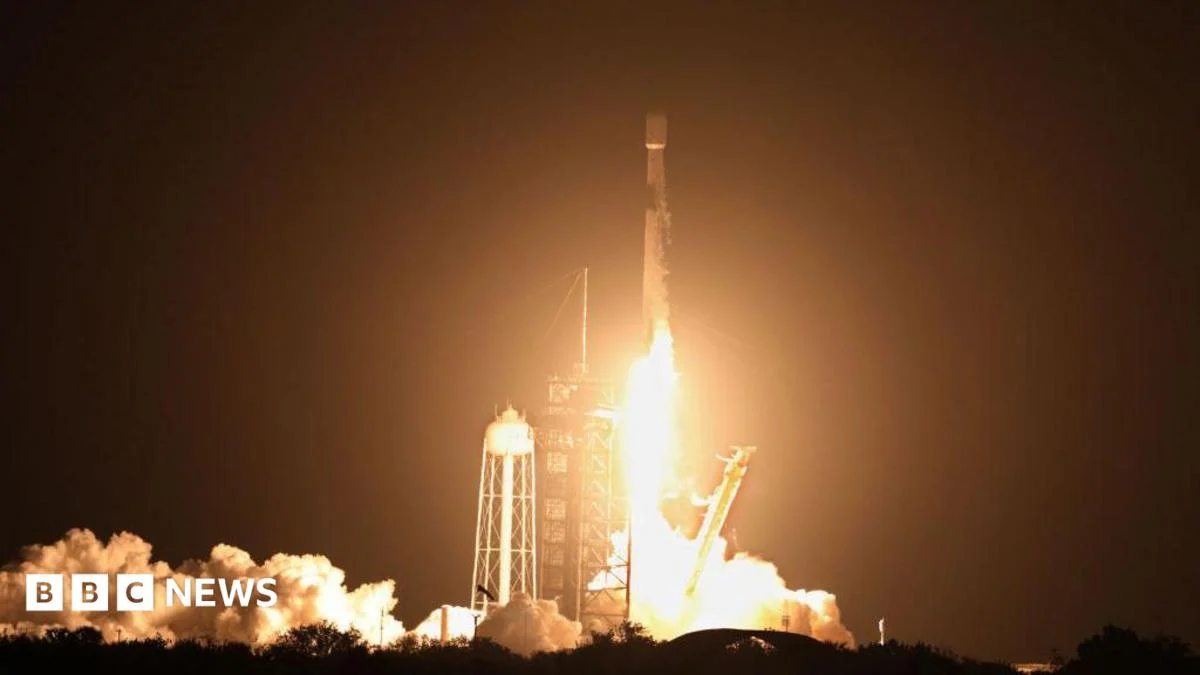
The Moon, our enduring celestial companion, bears the indelible scars of eons of cosmic bombardment. Its surface, a testament to geological time, is a tapestry of craters and basins, each a silent monument to countless impacts from asteroids and meteors. These natural phenomena have sculpted its distinctive pockmarked visage over millions of years. More recently, however, the Moon has also become a canvas for human-made imprints, experiencing collisions from the plucky probes, landers, and even defunct rocket stages that Earthbound space agencies have intentionally or unintentionally sent hurtling its way.
Now, a new chapter in this history of lunar impacts is anticipated. On a hypothetical Wednesday, scientists predict the Moon will experience yet another collision, this time from a drifting SpaceX Falcon 9 rocket upper stage. This spent section of a formidable launch vehicle, now an unguided piece of space debris, has been travelling through the vacuum of space at an astonishing velocity of approximately 2.43 kilometres per second, or roughly 5,400 miles per hour, making its eventual rendezvous with the lunar surface an event of significant interest.
The specific upper stage in question, a section of one of SpaceX’s Falcon 9 rockets, is projected to "impact" the Moon on a hypothetical 5 August, according to the authoritative insights from NASA’s Centre for Near-Earth Object Studies (CNEOS). This conclusion was reached after a meticulous analysis by independent astronomers, who, leveraging publicly available tracking data, identified that a portion of the rocket, originating from a January 2025 launch mission, had inadvertently entered an accidental collision course with the Moon. This particular rocket likely propelled a deep-space payload, such as a climate observatory or an interplanetary probe, far beyond Earth’s gravitational influence, leaving its upper stage on an escape trajectory that, over time, intersected with the Moon’s orbital path.
While the prospect of a collision might evoke concerns, NASA has been swift to reassure the public that "there is no danger to Earth." A spokesperson, Jimi Russell, confirmed that the primary focus for NASA will be to "continue to track the booster for training purposes, as well as later observe the impact site for scientific purposes." This ongoing monitoring underscores the dual nature of this event: a cautionary tale about space debris and an unparalleled scientific opportunity.
The impending collision, hypothetically predicted to occur at approximately 02:35 EDT (06:35 GMT) on the designated Wednesday, is expected to captivate the attention of astronomers across the globe, spanning both amateur enthusiasts and seasoned professionals. Dr. Matt Bothwell, a public astronomer at the University of Cambridge, articulated the sentiment prevalent within the scientific community, remarking, "It’s something really huge smashing into the Moon. It’s not remotely dangerous, we can just watch the show." He further elaborated on the anticipated spectacle: "It’s going to impact and it’s going to send up a huge plume of dust, maybe 50km into the air or more, and that’s going to spread sideways over time."
The mechanics of this lunar impact are inherently more dramatic than any comparable event on Earth. Given the Moon’s absolute lack of an atmosphere, there will be no atmospheric drag to slow the incoming object down. Similarly, its significantly weaker gravitational pull means that the resulting ejecta will behave differently. Dr. Bothwell explained that the moment of impact will be "more impressive than any [similar] explosion on Earth." Nothing will impede the rocket stage’s velocity before it strikes the surface, and nothing will significantly prevent the estimated million kilograms of pulverised rock and debris from rocketing up into space, creating a temporary, but vast, cloud of lunar material.
While the impact itself will not be visible from Earth with the naked eye, those equipped with sophisticated telescopes may be able to discern a fleeting flash of light radiating off the Moon’s surface at the precise moment of collision. This momentary brightening will be a key indicator for observers, signaling the violent release of energy as the metallic structure meets the ancient lunar regolith.
Beyond the immediate visual spectacle, the more profound significance of this event lies in its educative potential, as Dr. Bothwell noted. This accidental collision presents a truly unique and unplanned opportunity to study the dynamics of what happens when a substantial object strikes the Moon. Scientists are therefore meticulously gearing up to watch the event closely, transforming an unfortunate incident into a valuable experiment.
An array of advanced instruments will be focused on the impact site. Large ground-based telescopes situated in the Americas, poised to observe the initial flash, will work in concert with orbiting spacecraft. NASA’s Lunar Reconnaissance Orbiter (LRO), a veteran lunar scout, along with South Korea’s relatively newer Danuri probe, will meticulously track the evolving dust plume and, subsequently, image the newly formed crater. Furthermore, a citizen science project is actively recruiting keen amateur astronomers to film the impact, contributing their observations to a collective scientific effort.
By capturing the dust plume in action – its height, its dispersal pattern, and how the material eventually falls back to the surface – astronomers hope to refine their existing models of lunar impacts. This data is crucial for understanding the Moon’s geological processes, the effects of micrometeoroid bombardment, and even the potential hazards for future lunar habitats. Observing the precise characteristics of the ejecta could also provide invaluable clues about what lies just beneath the surface at the impact site, exposing fresh, subsurface material for scientific analysis for the very first time. This offers a rare glimpse into the composition and layering of the lunar crust without the need for a dedicated drilling mission.
Dr. Bothwell also underscored a broader, more sobering implication of this event, describing the collision as a cautionary tale about the ever-accumulating issue of human-made space clutter. "I think more people should be more worried about space debris," he asserted. "Every single year we put more stuff in orbit. Sometimes the satellites just collide, and they shatter into more pieces. I think there’s a worry about a runaway cascade, if we put so much stuff in orbit." This concern references the "Kessler Syndrome," a theoretical scenario where the density of objects in low Earth orbit becomes so high that collisions between objects cause a cascade of new space debris, rendering space travel and satellite operations increasingly hazardous or even impossible.
The statistics from the European Space Agency (ESA) paint a stark picture: there are an estimated 54,000 objects floating in space that measure larger than 10cm. This count doesn’t even include the millions of smaller fragments. In total, since the dawn of the Space Age in 1957 with the launch of Sputnik 1, humanity has launched approximately 17,000 tonnes of objects into Earth orbit and beyond. While the Falcon 9 upper stage impacting the Moon is an extreme example of this debris, it highlights the growing footprint of human activity in the cosmos.
This impending collision is not without precedent in the history of human-made objects interacting with the Moon. The last known dead rocket to impact the Moon was in March 2022, when the Chinese Long March 3C upper stage from the 2014 Chang’e 5-T1 mission inadvertently struck the far side of the Moon – the hemisphere that perpetually faces away from Earth. This event, while also accidental, was largely unobserved due to its location.
Decades earlier, during the height of the Apollo missions, NASA deliberately launched the upper stages of Saturn V rockets (specifically, the S-IVB stages) into the Moon. These intentional impacts served a critical scientific purpose: they created artificial moonquakes, which were then detected by seismometers deployed by Apollo astronauts on the lunar surface. The data collected from these controlled experiments provided invaluable insights into the Moon’s internal structure and composition, helping scientists to understand its deep interior.
Ultimately, the predicted collision of a SpaceX Falcon 9 upper stage with the Moon on 5 August encapsulates a unique moment in space exploration. It serves as a fascinating, albeit accidental, scientific experiment, promising to yield new data on lunar geology and impact dynamics. Simultaneously, it stands as a stark, tangible reminder of the ever-growing challenge of space debris, urging us to consider the long-term environmental consequences of our ambitious ventures beyond Earth. This event underscores both the boundless potential for scientific discovery and the increasing responsibility that comes with our expanding presence in the cosmos.




 atisusanti
 George Anjay
 Nakalama John

 Ramos Leo