atisusanti
Until a few years ago, many of us may have been blissfully unaware of what a data centre was. These giant, warehouse-like buildings are the unsung heroes of our digital lives, powering virtually all our internet activity, from the mundane web searches and emails to the more engaging movie downloads and online banking. More critically, they are the bedrock of the current artificial intelligence boom, housing the advanced computer chips and servers essential for running sophisticated services like ChatGPT and Claude. However, the breakneck speed of their global expansion, coupled with their voracious appetite for electricity and growing concerns about their environmental footprint, is igniting a significant public backlash worldwide. In the United States, this issue has escalated into a major point of contention ahead of the midterm elections on 3 November, with both Republicans and Democrats expressing opposition to further development. This puts proponents of data centre expansion on a direct collision course with figures like US President Donald Trump, who has publicly dismissed the growing pushback as a "sick conspiracy," even as public anger intensifies. This article delves into the burgeoning data centre industry and the escalating reasons behind the growing opposition.
They are growing rapidly
The sheer scale of the data centre industry is staggering. According to Data Center Map, a company that meticulously tracks both operational and pre-operational sites, there are approximately 12,250 data centres globally. This figure represents a substantial increase from 2021, when the number of operational sites stood at around 8,000. As the accompanying chart illustrates, the United States boasts the highest concentration of these facilities, with a formidable 4,767 sites. Europe follows, with the United Kingdom and Germany leading the pack. Historically, data centres have been strategically located near urban centres to ensure easy access to high-voltage power lines and crucial water resources for cooling. However, with their ever-increasing size, a notable trend has emerged: more facilities are now being established in rural areas.

The visual representation of data centre density worldwide highlights the significant dominance of the United States, with Virginia specifically identified as the region with the highest concentration globally. Europe exhibits a broad cluster of data centres spanning western and northern regions. In Asia, major hubs are discernible around Tokyo, Shanghai, Hong Kong, Singapore, and Jakarta, with smaller clusters scattered across other parts of the continent.
Further analysis of installed data centre capacity, measured in gigawatts (GW), reinforces this geographical distribution. The US leads with a substantial 53.73GW, dwarfing China’s 31.90GW. The European Union accounts for 11.92GW, with the rest of the world contributing 11.89GW. Japan and South Korea together have 6.58GW, India has 3.55GW, and the UK has 2.59GW. The treemap visually emphasizes the proportional size of each region’s capacity, clearly underscoring the immense scale of data centre infrastructure in the US and China.
They are getting bigger
Data centres exhibit a remarkable range in size, from compact units that can fit within the confines of a garden shed to colossal structures sprawling across vast tracts of land. The world’s largest operational data centre is widely reported to be operated by China Telecom in Hohhot, Inner Mongolia. This facility occupies an impressive area of approximately one million square metres (10.7 million sq ft), which is equivalent to about 140 FIFA football pitches. However, the scale of data centres under construction is set to surpass even these already enormous dimensions, as depicted in the subsequent graphic.

These burgeoning facilities are being built with a singular purpose: to provide the immense computing power required to operate advanced AI services. For instance, Colossus 2, a component of the broader Colossus campus, is designed to house hundreds of thousands of cutting-edge AI chips manufactured by the tech giant Nvidia. This facility will also be instrumental in training xAI’s chatbot, Grok. Elon Musk’s company plans to utilize 41 methane gas turbines to help power the site. Activists have raised concerns that this could "significantly increase" local air pollution, a claim supported by a study from the Sierra Environmental Law Center (SELC), which indicated potential worsening of regional air quality and millions of dollars in annual health damages. Local regulators, however, maintain that the turbines will meet established air quality standards.
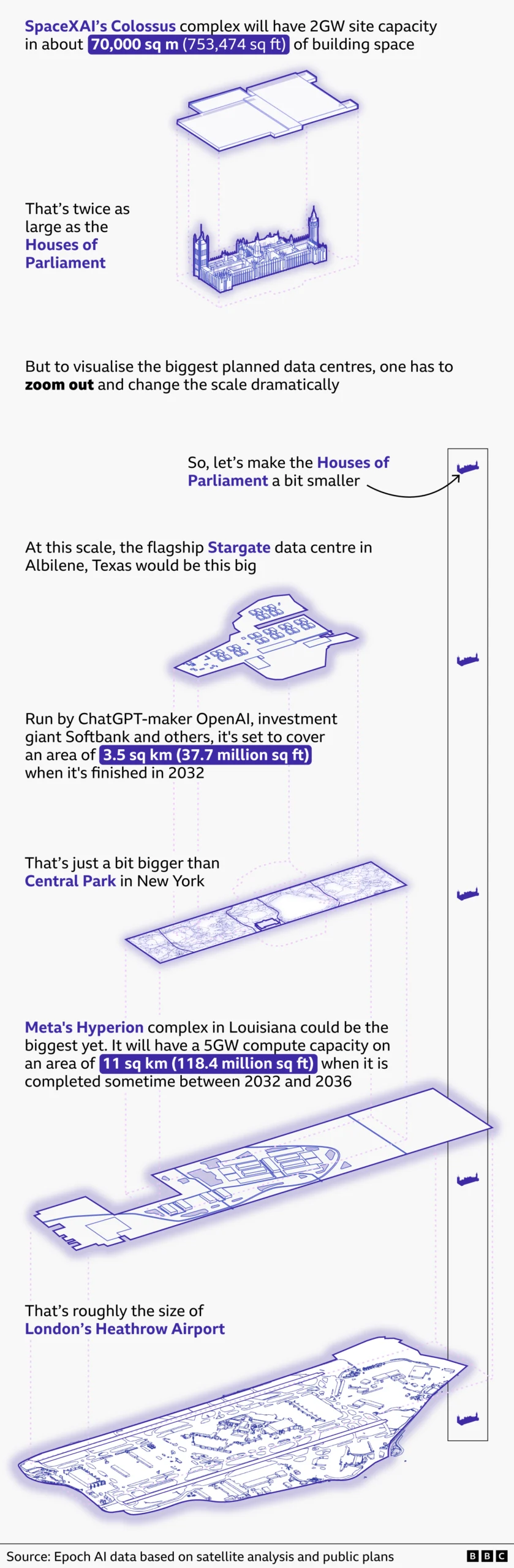
The visual comparison of major AI data centres starkly illustrates the escalating scale of planned infrastructure. SpaceXAI’s projected Colossus complex, spanning 70,000 square metres, is depicted as roughly twice the size of the Houses of Parliament. OpenAI-backed Stargate in Texas, covering 3.5 square kilometres, is juxtaposed with New York’s Central Park. Meta’s proposed Hyperion complex in Louisiana, an expansive 11 square kilometre development, is presented as being roughly the size of London Heathrow Airport, providing a vivid representation of the immense physical footprint of these AI hubs.
Furthermore, a comparison of satellite imagery in Tennessee reveals the dramatic transformation of a wooded area. An image from 2020 shows dense forest surrounding a modest industrial facility. By 2026, the same site will be dominated by a vast industrial complex following the development of SpaceXAI’s Colossus 2 data centre. The woodland will be largely cleared to accommodate multiple large buildings, explicitly labelled "MACROHARD" and "MACROHARDER," signifying the sheer scale of this AI-driven construction.
They use more electricity than France

The strain that data centres place on local resources is a growing source of concern. These facilities can consume substantial quantities of water for cooling their intricate systems, potentially leading to significant water shortages, according to some experts. Moreover, data centres worldwide are estimated to consume more electricity than the entire nation of France, as evidenced by the accompanying chart.
This escalating demand for power contributes to rising carbon emissions, as indicated by recent analysis. It also places considerable pressure on local power grids, raising fears among some that this could lead to increased energy prices for consumers. Coupled with concerns about the noise generated by data centres and the significant land area they occupy, a potent public backlash is rapidly gaining momentum. In response, 16 US states have proposed legislation to ban or temporarily halt the construction of new facilities, indicating that this issue is poised to be a pivotal point in the upcoming November midterm elections. Outside the US, opposition to data centres has also emerged in countries such as Mexico, France, Indonesia, and the UK, demonstrating a global trend of concern.
But they can boost jobs
Despite the growing criticisms, proponents of data centres argue that they are indispensable for national security and the continued advancement of artificial intelligence. They also assert that these facilities are beneficial for the economy, attracting substantial investment, generating valuable tax revenue, and creating employment opportunities, particularly in the construction sector. A recent report by the Brookings Center offers supporting evidence, suggesting that data centres do contribute to local job creation, although the number of jobs generated may be fewer than industry advocates often claim.

The type of data centre also plays a crucial role in its economic impact. The report highlights that "hyperscale" facilities – the massive sites owned and operated by tech behemoths like Amazon and Microsoft – tend to have a more pronounced positive effect on employment. In contrast, "colocation" facilities, which primarily lease space to remote tenants without a significant local presence, offer fewer economic benefits.
As the debate surrounding the merits and drawbacks of data centres intensifies, their rollout continues unabated. This year, the tech industry is projected to invest a combined $765 billion in AI infrastructure, with this figure expected to surpass $1 trillion next year. However, as concerns about the environmental impact escalate, the tech industry is actively exploring alternative solutions. One intriguing concept involves relocating data centres to space or even to the Moon, where they could potentially harness abundant solar energy. Another prediction suggests that a significant portion of AI processing could eventually be handled by the hardware already integrated into our personal computers and smartphones, thereby diminishing the necessity for the vast, land-intensive data centres that are currently proliferating.
Additional reporting and design by Erwan Rivault, Matt Faraci, and Dominic Bailey.




 Nana Banana

 Roy Suryo

 Nakalama John

 George Anjay